
HARDWARE HACKER
&
LOW LEVEL HACKER
BASED IN INDONESIA
by: Antonius
Country: Indonesia
https://www.bluedragonsec.com - https://github.com/bluedragonsecurity
It's been a long time since I last did Linux kernel exploit research; the last time was back in the Linux 2.6 era, right before I shifted my focus to kernel rootkits. However, in 2026, a fascinating development in Linux 7.0 brought me back to the field. It revolves around a fundamental shift in the kernel heap exploitation paradigm - moving toward a mindset of 'Hijacking the Allocator State.
I have conducted deep research since Linux 7.0-rc1 and even reverse-engineered the mechanics of these SLUB sheaves. This writing is based on Linux 7.0-rc7 source code, but can be applied to any Linux 7.* series.
Linux kernel 7.0-rc7 & linux kernel 7.0 mainline uses the SLUB Sheaves architecture, replacing the legacy kmem_cache_cpu structure. In this new architecture, each sheaf is represented by struct slab_sheaf, declared at mm/slub.c line 404 in Linux kernel 7.0-rc7.
From source code analysis of Linux kernel 7.0-rc7, one of the most interesting design characteristics of struct slab_sheaf is the use of a union at the beginning of the struct. This union allows the same block of memory to be used for three different purposes depending on context. The Linux kernel use-after-free exploitation technique using slab_sheaf Union State Confusion is directly related to the ambiguity that arises from the use of this union.
Below is the complete declaration of the union portion of struct slab_sheaf, verified directly from the linux-7.0-rc7 & linux-7.0 Mainline source tree (both at the same line number):
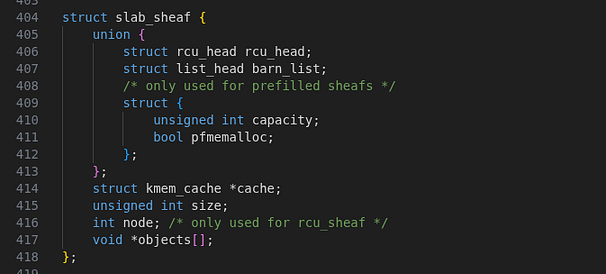
This union does not add alias names. All three variants are directly accessible through their respective field names (rcu_head, barn_list, capacity, pfmemalloc).
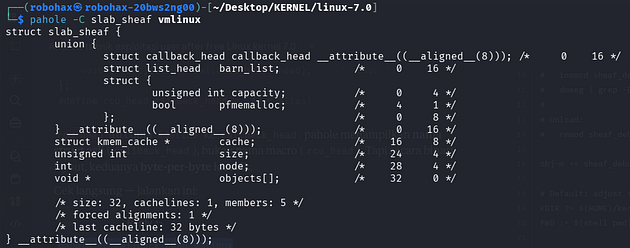
Although the three union variants are declared separately, in memory they all occupy the exact same byte range, starting from offset +0x00 of struct slab_sheaf.

The first column shows that rcu_head.next and barn_list.next are at an identical offset (+0x00).
Likewise rcu_head.func and barn_list.prev are both at +0x08. This is a direct consequence of how unions work in C: all union members share the same starting address.
This is a direct consequence of how unions work in C: all members of a union share the same starting address. There is no memory separation between them.
Understanding the type of each field is important for grasping the meaning of this overlap.
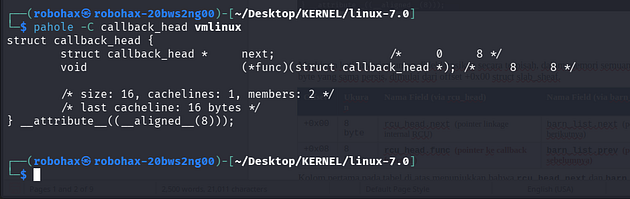
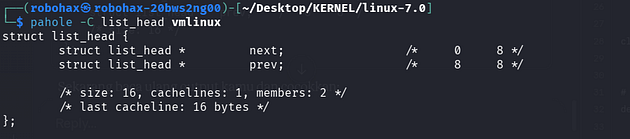
Below are the actual definitions of the two structs involved:
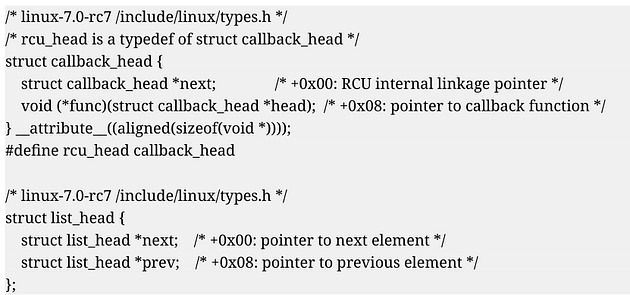
The most critical difference is at offset +0x08: in the rcu_head context, the byte at this position is a pointer to a callback function. In the barn_list context, the same byte is a pointer to the previous element in the barn’s doubly-linked list. A single 8-byte block of memory is interpreted
as two different things depending on which code path reads it.
To avoid confusion about this union, we first need to understand the life cycle of a slab_sheaf in kernel 7.0-rc7.
At any given time, a slab_sheaf may be in one of the following states:

The critical transitions are between the IN_BARN and RCU_PENDING states. When a sheaf is moved from the barn to the RCU path:
1. list_del(&sheaf->barn_list) is called when the sheaf is removed from the barn (mm/slub.c:3103, 3155, 3192). After this, barn_list.next (+0x00) and barn_list.prev (+0x08) contain LIST_POISON1 and LIST_POISON2 respectively, set unconditionally by list_del().
2. The sheaf is placed into pcs->rcu_free: the union still contains the LIST_POISON values from list_del().
3. When the sheaf is full: call_rcu(&sheaf->rcu_head, rcu_free_sheaf) is called (mm/slub.c:5949). The RCU infrastructure writes rcu_head.next (+0x00) as RCU internal linkage, and rcu_head.func (+0x08) as &rcu_free_sheaf - overwriting the previous values.
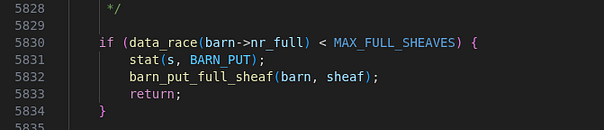
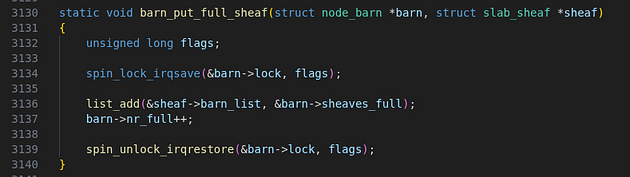
The reverse direction also applies. In rcu_free_sheaf() (mm/slub.c:5789), after the RCU grace period completes, if the barn has free slots, the sheaf is returned to the barn:
This technique centers on one question: is there a moment where the kernel reads or writes the slab_sheaf union with an interpretation inconsistent with the sheaf’s actual state?
struct slab_sheaf has no explicit field recording which state is currently active. There is no enum state, no BARN_OR_RCU flag. The kernel determines the correct interpretation solely from program flow context. This is common in C based kernel code and is not inherently flawed, but it
creates a dependency on the validity of operation ordering.
Consider the following flow in __kfree_rcu_sheaf() (mm/slub.c around line 5862):
/* linux-7.0-rc7 /mm/slub.c:5862 — __kfree_rcu_sheaf() */
bool __kfree_rcu_sheaf(struct kmem_cache *s, void *obj)
{
/* Step 1: rcu_free sheaf obtained from spare or barn */
do_free:
rcu_sheaf = pcs->rcu_free;
/* Step 2: objects are collected into objects[] */
rcu_sheaf->objects[rcu_sheaf->size++] = obj;
/* Step 3: when sheaf is full, call_rcu is invoked */
if (likely(rcu_sheaf->size < s->sheaf_capacity)) {
rcu_sheaf = NULL;
} else {
pcs->rcu_free = NULL;
rcu_sheaf->node = numa_mem_id();
}
if (rcu_sheaf)
call_rcu(&rcu_sheaf->rcu_head, rcu_free_sheaf);
/* call_rcu writes:
* rcu_head.next (+0x00) = RCU internal linkage
* rcu_head.func (+0x08) = &rcu_free_sheaf */
}
After the RCU grace period completes and the callback is invoked in rcu_free_sheaf() (mm/slub.c:5789), if the barn has free slots, barn_put_full_sheaf() calls list_add(&sheaf->barn_list, …). This writes to barn_list.next (+0x00) and barn_list.prev (+0x08), overwriting rcu_head.next and rcu_head.func respectively.
If there is a write primitive that can modify the slab_sheaf union while in the RCU_PENDING state, the value written to offset +0x08 will be interpreted by the RCU infrastructure as a pointer to a callback function. Symmetrically, modification in the IN_BARN state to offset +0x08 will carry over as rcu_head.func when the sheaf transitions to the RCU path.
Modification at offset +0x08 is the most interesting point for exploitation because it touches rcu_head.func, a function pointer called by the RCU mechanism after the grace period.
To understand this exploitation technique more completely, below is a full slab_sheaf life cycle diagram with the relevant union transition points:

It is important to stress that this technique is not a vulnerability that can be exploited directly from scratch. It is a design property that amplifies the impact when some other bug already exists.
Initial access primitive: there must be another vulnerability (UAF, buffer overflow, race condition) that provides ability to read or write memory overlapping with a slab_sheaf.
Correct timing: (a) For poisoning via IN_BARN: write to offset +0x08 while sheaf is in barn. (b) For direct overwrite: write to offset +0x08 after call_rcu() but before grace period completes (window of hundreds of microseconds to milliseconds).
Sheaf location knowledge: the attacker must know the target slab_sheaf address, generally requiring a separate information leak or converting a UAF write to provide information leak (heap leaks).
In other terms: this technique is an amplifier, not an initial vector.
In other words, this technique is an amplifier, not an initial vector. It turns a limited memory access primitive into something potentially more significant because the manipulated value carries special meaning for kernel infrastructure (the RCU machinery or barn list management).
The slab_sheaf Union State Confusion technique centers on one architectural fact: struct slab_sheaf uses a union to overlay rcu_head and barn_list at the same memory offsets, without an explicit state marker.
The critical point is offset +0x08, where barn_list.prev and rcu_head.func overwrite each other. In the RCU context, this is a function pointer called after the grace period. In the barn context, it is a list pointer. This technique can be adapted for linux kernel 7.0 mainline.
The core idea is simple: one write, two interpretations. The attacker writes as ordinary data, the kernel reads it as a function address and jumps to it. That is “state confusion" confusion between two contexts that share the same memory.

RoboMall was developed by Antonius (w1sdom) in 2023, The robot was designed to be operated in a mall. The purpose is that mall visitors doesn't need to visit mall directly, instead, they can use this robot to stroll in a mall and if they deposit in RoboMall wallet system they can buy things on mall, then the goods will be delivered by couriers.
Robotsoft LightBox is a solar powered outdoor lighting. Features : water proof, controlled by voice & android application. This product was created by Antonius (w1sdom). This product was created for his startup Robotsoft in 2020.
Robotsoft FloorLight is a solar powered outdoor lighting. Features : water proof, controlled by voice & android application. This product was created by Antonius (w1sdom). This product was created for his startup Robotsoft in 2020.
Robotsoft Torch is a solar powered outdoor lighting. Features : water proof, controlled by voice & android application. This product was created by Antonius (w1sdom). This product was created for his startup Robotsoft in 2020.
Solar Powered Electrical Generator. This generator created by Antonius (w1sdom). This product created for his startup Robotsoft in 2020.
This is an exploit for CVE-2026-46215 (Linux Kernel Use After Free) Adapted for Linux 7.0 !!! This exploit is more stable and reliable than the first exploit I released.
This is an exploit for CVE-2026-46215 (Linux Kernel Use After Free) Adapted for Linux 7.0 !!! WARNING !!! this exploit is not stable ! sometimes, this exploit might cause kernel panic !
2026 Buptlab Dns Relay Server Remote Dos - for Linux. Lame remote denial of service exploit for buptlab dns relay server. Bug was discovered by Antonius (w1sdom) in 2026.
Lame remote denial of service exploit for litedns dns server - Bug Discovered by Antonius (w1sdom) in 2026.
rldns-1.0 - rldns-1.3 remote denial of service exploit. (rldns is an open source dns server that I developed).
CVE-2022-0847 - Linux Kernel 5.8 < 5.15.25 Local Privilege Escalation Exploit (DirtyPipe 2). github : https://github.com/bluedragonsecurity web : https://www.bluedragonsec.com
Private Bug !!! Savant Web Server 3.1 Post Method Buffer Overflow Denial of Service via HTTP Post. Vulnerability in HTTP Post discovered by Antonius. web : bluedragonsec.com - github.com/bluedragonsecurity
Minalic Web Server 2.0.0 Remote Stack Overflow Exploit Via HTTP Post Method - for Windows 32 bit - Python Version. This is the only version in internet that used post method in 2013. Since post method and get method used different code path, you can tell that I found the vulnerability for post method. Exploit target : Windows Server 2003 Service Pack 2, English
MinaliC Webserver Post Method Remote Buffer Overflow Exploit. Affected : MinaliC Webserver 2.0.0. Vulnerability in post method was invented by Antonius in 2013. Original code developed by Antonius in Apr 2013. Code patched in 2026. web : bluedragonsec.com - https://github.com/bluedragonsecurity
Private Exploit !!! EasyFTP Server 1.7.0.2 - 17.0.11 Remote Buffer Overflow. Original code using python 2.6 developed in 2013. Code patched in 2026 -> adjustment for python3. Exploit developed by Antonius (w1sdom) - bluedragonsec.com - https://github.com/bluedragonsecurity
Private Exploit !!! EasyFTP Server 1.7.0.2 - 17.0.11 Remote Buffer Overflow. Original code using python 2.6 developed in 2013 ported to C (Linux), patched in 2026. Exploit developed by Antonius (w1sdom) - bluedragonsec.com - https://github.com/bluedragonsecurity
Private Exploit !!! CVE-2012-10023 FreeFloat FTP Server 1.0 Remote Stack Overflow Exploit. Code : Antonius (w1sdom) - bluedragonsec.com. Original code developed in 2013 - exploit patched in 2026 https://github.com/bluedragonsecurity
Stack-based buffer overflow in MinaliC Webserver 2.0.0 allows remote attackers to execute arbitrary code via a crafted HTTP POST request. The overflow occurs in the URI parsing routine when processing the POST method, which follows a separate code path from GET. Existing CVEs for MinaliC do not cover this vulnerability. Discovered by Antonius in 2013.
Affected : MinaliC Webserver 2.0.0Buffer overflow in Savant Web Server 3.1 allows remote unauthenticated attackers to crash the server (denial of service) via a crafted HTTP POST request with an oversized URI and body. Existing CVEs for Savant cover the GET-method overflow only. This vulnerability uses the POST method which hits a different code path. Discovered by Antonius in 2013.
Affected : Savant Web Server 3.1curr_end becomes stale after VMA merge in mseal_apply(), leading to incorrect sealing state. Affects Linux kernels 6.17–7.0-rc5. Fix authored by Lorenzo Stoakes (Oracle). Vulnerability discovered by Antonius
Affected : Linux 6.17 – 7.0-rc5Heap OOB read vulnerability in rldns 1.3 DNS server. Fixed in rldns 1.4 with comprehensive fuzzing via honggfuzz and improved input validation. Vulnerability discovered by Antonius.
Affected : rldns 1.3Type Confusion / Cross-Cache Free (Slab Cache Confusion) in the Linux Kernel (versions ≥ 6.3 and < 6.12.82). This vulnerability involves a pointer allocated within Cache A but subsequently freed into Cache B. Discovered by Antonius.
Affected : Linux net/bpf · fix: 0f42e3f4fe2aOut-of-bounds Read leading to Denial of Service (DoS). Vulnerability discovered by Antonius.
Affected :Remote Heap-Based Buffer Underflow, 1-byte Heap Underwrite / Out-of-Bounds Write, Network-triggerable via crafted UDP DNS packet. Vulnerability discovered by Antonius.
Affected :Part 5 of x86_64 linux remote stack overflow exploitation series from bluedragonsec.com
Part 4 of x86_64 linux remote stack overflow exploitation series from bluedragonsec.com
Part 3 of x86_64 linux remote stack overflow exploitation series from bluedragonsec.com
Part 2 of x86_64 remote stack overflow exploitation for x86_64 linux, covering ret2plt. The writing is still on a non la57 linux system.
This guide is about basic of remote stack overflow exploitation on x86_64 linux. This one is the first guide from a series.
A story about a lamer who started learning in 1996 and is still a lamer in 2026.
This is a very old write-up about CVE-2005-0575 Remote Exploitation, this is very old and might not be relevant anymore ! you have been warned ! I forgot when I made it. This is translated from Indonesian language (as always).
I released 8 pdf(s) Tutorial for Beginner Hacker. I wrote this in January 2026. I translate this materials from Indonesian Language.
Physical Attacks on LAN Networks is part of security training materials that I gave to Indonesian Police. This writing is a translation of some parts of my training materials about physical attacks (I haven't had time to release some details on "how to make the hacking devices", it's planned to be released in the future - the electronic parts & the codes).
Unconventional bio hacking technique to defeat convnet face recognition algorithm ! The Art of Creativity !
Novel UAF exploitation technique targeting the new SLUB sheaves architecture introduced in Linux 7, leveraging union state confusion in slab_sheaf objects for kernel privilege escalation. This is "The Art of Hijacking the Allocator State"
Step-by-step walkthrough of constructing a kernel ROP chain to bypass SMEP & SMAP on Linux Kernel 6.17.
I am Antonius (w1sdom), a security researcher based in Indonesia (but Chinese). I am a polymath type security researcher with strong knowledge in "hardware hacking (robotics)" and "low level exploitation".
I Learnt electronics in 1996 and then learnt to write 16 bit asm virus in 1998-2001.
I combine multiple disciplines in robotics, electronics, low level exploitation, hardware hacking & artificial intelligence to create innovative technologies, novel hacking techniques and low level exploitation techniques.
w1sdom, sw0rdm4n, ev1lut10n, d4r3d3v1l, jck.marshall (one time usage), ringlayer, robotsoft, mranton, 黑蝎子, Prof. Robotsoft, Mr. Robot, etc...
Zodiac : Scorpio.
Born : 198x
INTJ - Polymath
Developed in 2014, this legendary Linux Kernel Rootkit was engineered to target Linux kernel versions 2.6.x through 3.x. Developed by Antonius (w1sdom / sw0rdm4n / ev1lut10n) --> https://packetstorm.news/files/id/128945
Trojanized version of openssh-8.0p1 where the ssh client will log the ssh username and ssh password into /opt/.../log.txt. Build 2024 - by Antonius (sw0rdm4n)
Lightweight DNS server · Linux / NetBSD / FreeBSD / OpenBSD · x86 / x86_64. Developed by Antonius (w1sdom / sw0rdm4n / ev1lut10n) - version 1.0 was released in 2017 --> https://packetstorm.news/files/id/141606
Ftrace-based LKM rootkit · Linux Kernel 5.x–6.2 · x86_64 - developed in 2023 by Antonius (w1sdom / sw0rdm4n / ev1lut10n) --> https://packetstorm.news/files/id/174805
FreeBSD 13 KLD rootkit · file / process / port hiding · bind shell - developed in 2023 by Antonius (w1sdom / sw0rdm4n / ev1lut10n) --> https://packetstorm.news/files/id/174806
LKM rootkit · Linux Kernel 5.x–6.2 · persistent - developed in 2023 by Antonius (w1sdom / sw0rdm4n / ev1lut10n) --> https://packetstorm.news/files/id/174789
Linux userland rootkit · file / process / port hiding by Antonius (w1sdom / sw0rdm4n / ev1lut10n) --> https://packetstorm.news/files/id/174790
Modified Cowrie for SSH man-in-the-middle attacks by Antonius (w1sdom / sw0rdm4n / ev1lut10n)
The first hacker robot that I created. This robot was developed in 2014. Some demo videos were posted in Youtube around 2016. This robot can explains about low level exploitation techniques. Robot skills : can hack wifi (wpa cracking using aircrack), evil twin, wifi deauth, arp cache poisoning. My old video channel --> https://www.youtube.com/@antoniusringlayer/videos
I planned to develop a spy robot, but this robot was too big. The chassis was created using metals. Developed in 2017, posted in youtube around 2019. Developed by Antonius (w1sdom)

Airhax is a wireless network auditor gadget. This device was created in 2015. This gadget functions : wifi cracking, evil twin, wifi deauth, arp poisoning. Developed by Antonius (w1sdom / sw0rdm4n / ev1lut10n / robotsoft)
I built this robot in 2014. It is a shy robot that is afraid of humans. I used 3 ultrasonic sensors.
A large-scale prototype robot powered by a mini PC and an Arduino, built as a personal project rather than a commercial product. At first, I planned to equip it with high-torque servos and an airsoft gun, but I realized that could be dangerous, so I scrapped the idea. Real hacking should be harmless. Build 2017 - by Prof. Antonius Robotsoft

Various Robots (finished and unfinished) - build by Antonius Robotsoft (w1sdom).
The home of the website
Electronic gadgets, robots, hacking devices, IOT, electrical generators from Robohax, Robotsoft and Bluedragonsec.
Prototypes for DIY gadgets, robots and quadcopters related to security that I developed.
My Low level exploits developed from 2001-2026
Videos about low level exploit developments, hardware hacking & prototypes.
Security vulnerabilities that I have discovered
Papers related to hardware hacking and low level exploitation.
Mostly about hardware hacking and low level exploitation.
About my website
Hacking tools, rootkits and open source projects that I developed


