Heap Based Buffer Over-Read Vulnerability in Rldns-1.3
Written by : Antonius (w1sdom)
Web : www.bluedragonsec.com
Github : https://github.com/bluedragonsecurity
Vulnerability discovered by Antonius (w1sdom)
CVE : CVE-2026-27831
Date of discovery : Feb 22 2026
First of all, I apologize if this write-up feels a bit “robotic.” As a roboticist and electronic engineer who spends most of my time building hardware, my writing style tends to be quite literal.
Vulnerability Discovery
During a fuzzing session with rldns-1.3, I discovered a heap-based out-of-bounds read vulnerability. I used honggfuzz 2.6 for this session.
What is Rldns? Rldns is an open-source DNS server project that I maintain.
You can find the archives here : https://github.com/bluedragonsecurity/rldns_archives
and the source codes for latest rldns here : https://github.com/bluedragonsecurity/rldns
Currently, the latest version is rldns-1.4.
In February 2026, I finally had some spare time to fuzz the server. Through this process, I identified several vulnerabilities in version 1.3, including null pointer dereferences and heap-based buffer over-reads - which was quite alarming since I am the developer!
Fuzzing Methodology & Environment
To detect memory corruption, I relied on AddressSanitizer (ASan). I used honggfuzz specifically to generate malformed DNS packets to trigger crashes.
I used the following CFLAGS and LDFLAGS to ensure ASan would capture the corruption details:
CFLAGS = -O1 -g -fno-omit-frame-pointer -fno-optimize-sibling-calls -D_FORTIFY_SOURCE=0 -fsanitize=address,undefined
LDFLAGS = -fsanitize=address,undefined
Full Makefile url :
https://raw.githubusercontent.com/bluedragonsecurity/rldns/refs/heads/main/Makefile_for_honggfuzz
To enable ASan logging, I created a shell script named run.sh to execute rldns
#!/bin/bash
pkill -9 rldns
echo "" > asan_log.txt
export ASAN_OPTIONS="log_path=stderr:abort_on_error=1:detect_leaks=0"
./rldns &>> asan_log.txt &
then I run rldns as root using that script :
./run.sh
Confirming the dns server is running :
Press enter or click to view image in full size
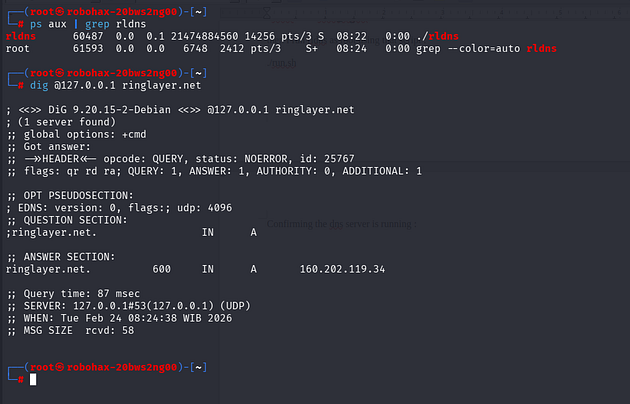
I have prepared dns corpus for honggfuzz, which can be downloaded here : https://github.com/bluedragonsecurity/corpus_for_honggfuzz
Next step, I used honggfuzz to generate various malformed dns packets for rldns :
honggfuzz -i dns_corpus -s - /bin/nc -u -n -w 1 127.0.0.1 53
Press enter or click to view image in full size
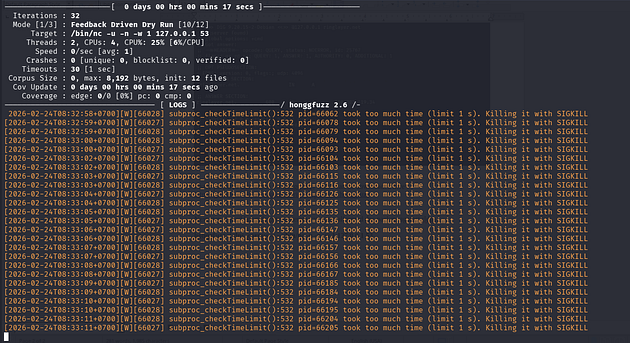
Crash Analysis
Once rldns crashed, the ASan log reported a READ of size 16:
READ of size 16 at 0x7bff60fe0a7f thread T0
#0 0x7fdf62c7e4ce in strlen ../../../../src/libsanitizer/sanitizer_common/sanitizer_common_interceptors.inc:425
#1 0x564dea55f3fa in _count_octet_length src/main.c:1021
#2 0x564dea55f3fa in parse_enumerate_and_fetch_each_octet_and_just_return_a_name src/main.c:667
#3 0x564dea561d80 in rldns_main src/main.c:1943
#4 0x564dea568cb7 in main src/main.c:1882
#5 0x7fdf62029f67 in __libc_start_call_main ../sysdeps/nptl/libc_start_call_main.h:58
#6 0x7fdf6202a024 in __libc_start_main_impl ../csu/libc-start.c:360
#7 0x564dea552690 in _start (/home/robohax/Desktop/CVE/rldns Remote Heap-Based Buffer Over-read/rldns-1.3/rldns+0x2f690) (BuildId: b895cc58067deb351b9d579ecbaa4f52e8b2b4f1)
The vulnerability is triggered because the strlen function encounters an out-of-bounds read. Specifically, if a_name contains invalid bytes (like 0xff), strlen may result in a segmentation fault.
The bug originates in the function parse_enumerate_and_fetch_each_octet_and_just_return_a_name at src/main.c:667. The routines responsible for building the name from a DNS query do not properly null-terminate the string. When a malformed packet ends with a non-null byte (e.g., 0xff), the subsequent call to strlen(a_name) reads past the boundary of the allocated heap buffer.
Capturing the Malformed Packet
Since honggfuzz does not automatically log the specific packet that causes a crash, I created a shared object (dns_logger.c) to hook the recvfrom function and log the last received packet to /tmp/last_packet.dns
You can find the dns_logger.c here : https://github.com/bluedragonsecurity/rldns-1.3-heap-out-of-bounds-vulnerability-fixed-in-rldns-1.4/blob/main/dns_logger.c
Next, I compile it as shared object :
gcc -fPIC -shared -o dns_logger.so dns_logger.c -ldl
Since this shared object can not be preloded when ASan activated, I use the original Makefile from rldns-1.3 :
https://raw.githubusercontent.com/bluedragonsecurity/rldns-1.3-heap-out-of-bounds-vulnerability-fixed-in-rldns-1.4/refs/heads/main/Makefile
Recompile to test and run the rldns with LD_PRELOAD:
make clean && make
cp dns_logger.so /tmp/dns_logger.so
LD_PRELOAD=/tmp/dns_logger.so ./rldns
Next, I execute honggfuzz :
honggfuzz -i dns_corpus -s - /bin/nc -u -n -w 1 127.0.0.1 53
Once rldns-1.3 crashes, I got the last dns packet from honggfuzz at /tmp/last_packet.dns
Press enter or click to view image in full size
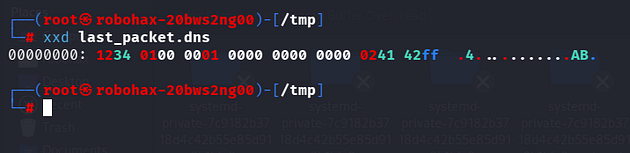
Using xxd, we know that it’s a malformed dns packet, since it contains only 16 bytes and ended with 0xff.
Press enter or click to view image in full size
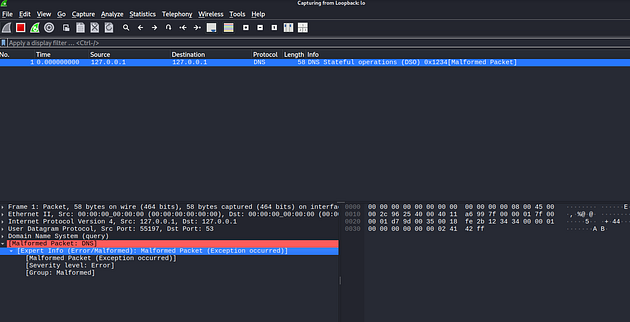
The POC
The PoC that crashes rldns-1.3 is available here:
https://github.com/bluedragonsecurity/rldns-1.3-heap-out-of-bounds-vulnerability-fixed-in-rldns-1.4/
I expect to be busy over the next three years developing intelligence/hacking devices and hunting for 0-days. If you discover any vulnerabilities in rldns, please report them to me at: [email protected].
