The Story of A Lamer - From Zero to Zero
Before Discovering Computers

Going back to 1996, when I was still in school, I was introduced to a new extracurricular activity: electronics. At that time, I learned how to make printed circuit boards (PCBs) using ferric chloride and marker pens, how to solder, and the fundamentals of electronic schematics. Things were not as easy as they are today — I had no knowledge of PCB design software because I had not yet encountered computers, so everything was done manually.
First Encounter with Computers

In 1998, I gained access to another new extracurricular activity at school: an introduction to computers. At that time, what I studied included MS-DOS, Windows 3.x, Windows 95, Windows 98, Lotus 1–2–3 (a spreadsheet application similar to Microsoft Excel), dBASE III Plus (a database application similar to Microsoft Access), and WordStar (a word processor similar to Microsoft Word).

I was particularly fascinated by MS-DOS — I could spend hours simply exploring the MS-DOS environment. In addition, there were some interesting games available on MS-DOS that I played, including Quake and Doom. For Quake in particular, I spent more time tinkering with MS-DOS than actually playing the game.

First Encounter with Hacking
At the end of 1998, I went to a bookstore with my mother. As usual, after visiting the martial arts section, I made my way to the computer books section. There, I came across a book that immediately caught my curiosity: “Rahasia Pembuatan Virus Komputer” (The Secrets of Computer Virus Creation), published in 1997 and written by two hackers under the pseudonyms Synomadeous and Denny Zip. Intrigued, I purchased the book.
The book was written in Indonesian and covered techniques for creating computer viruses in MS-DOS using 16-bit assembly language on the 8086 architecture. It included several virus source codes — viruses that spread via files and floppy disks, as well as Master Boot Record (MBR) viruses that infected boot sectors. Infecting .COM files was simpler than .EXE files due to their smaller size and straightforward structure.

To compile the assembly source code from the book, I needed a compiler and linker. I downloaded TASM (Turbo Assembler) 2.0 and its linker TLINK (Turbo Linker) 1.0 from the internet. After compiling and linking the code, I released one of the viruses from the book into my school’s computer lab. As a result, every student who needed to use the computers for practice was unable to do so due to the damage caused by the virus I had spread.
Eventually, I was called in by a teacher — I was suspected because I was the one most frequently found in the school lab. As a consequence, I was suspended for three days.
Some well-known viruses at that era : ufo virus (created by indonesian virus writer), denzuko virus (created by indonesian virus writer, suspected to live in Bandung), alexander virus, stone virus,etc.
Returning to Being a Normal Student

After the three-day suspension, I learned my lesson and stopped spreading viruses in the school lab. My days in the lab were spent studying WordStar, dBASE III Plus, Lotus 1–2–3, MS-DOS, Microsoft Excel, and Microsoft Word on Windows 98.

Getting into Trouble Again
Before being accepted into a public university and enrolling in an economics program, I spent one year studying Management Information Systems at a polytechnic called AMIK Masa Depan.

At this institution, I studied various new programming languages, including Pascal, Visual Basic, and JavaScript. Of all of them, Pascal was my favorite. Since I did not have a computer at home, I often wrote Pascal programs by hand in a notebook with a pencil, planning to type them up later on the campus computers.
The compiler I used for Pascal was Turbo Pascal version 7.0, which ran within the MS-DOS environment.
At AMIK Masa Depan, I got into trouble again. I carelessly spread a Windows computer virus built with Visual Basic. Because I was the one who was most visibly spending all day in the campus computer lab tinkering with machines, the lecturer immediately knew I was responsible. I was called into the faculty room and reprimanded, though a few of the lecturers appeared to be suppressing smiles — perhaps amused to encounter such a computer-obsessed student.
Acceptance into a Public University

After a year at the polytechnic, I sat for the national public university entrance examination and was accepted. I consequently did not continue my studies in Management Information Systems. I was enrolled at Jenderal Soedirman University (UNSOED) in the Department of Development Economics.
My Days as a Script Kiddie
During my university years, I spent countless hours in the library, the campus computer lab, or at internet cafes. Online, I frequented public-access Unix systems (SDF Lonestar and M-Net Arbornet), IRC channels, BBS platforms, and Gopher.
There were various security sites that I used to visit at that time, such as…
https://web.archive.org/web/20010302030916/http://www.guninski.com/
phrack.org
https://web.archive.org/web/20010721220134/packetstormsecurity.com
https://web.archive.org/web/20010202072100/http://hackers.com/
https://web.archive.org/web/20010224174743/http://www.astalavista.com/
https://web.archive.org/web/20010119000200/progenic.com
https://web.archive.org/web/20010203133300/http://blacksun.box.sk/
https://web.archive.org/web/20010202053900/neworder.box.sk
https://web.archive.org/web/20010208164128/http://team-teso.net/
https://web.archive.org/web/20010209124902/w00w00.org
https://web.archive.org/web/20040708083715/http://thc.org/
I also engaged in mischievous activities such as downloading trojans from astalavista.com and installing them on other computers within the local area network.

Some well-known trojans of that era included NetBus and Back Orifice by Cult of the Dead Cow. NetBus was notable for disguising its client as a Whack-a-Mole game, so victims had no idea it was a trojan horse. The tool I used most frequently was Pest version 3.1, which was available for download on astalavista.com. Using the trojans I installed, I was able to see what victims were browsing, move their mouse cursor, and send keystrokes to their computers.

Beyond trojans, other tools I used included SuperScan and nmap GUI, JTR (cli), nmap (cli), hydra. For exploits, I used exploits such as the iis webdav exploit, wu-ftpd exploit, iis unicode exploit, etc which I compiled on a campus computer running Mandrake Linux 9.

At the time, BBS and Gopher were rarely accessed by the general public — I continued using them because I was a nerd. BBS, which had previously been accessible via dial-up, had by then largely transitioned to being accessible via Telnet on port 23.


During that period, there was a particularly interesting public-access system running OpenVMS. As of 2026, there is still one public OpenVMS server that can be tried (though it is a new server): https://encompasserve.org
Hacking Scene in Indonesia (2001–2004)
I didn’t socialize with Indonesian hackers at all, I have been afraid of being ostracized from May 1998 until the end of 2006.

I visited the ‘Kecoak Elektronik’ website around 2001. I found it quite amusing that the site displayed the visitor’s IP address, considering that it can be easily implemented using a simple PHP snippet:
In 2003, I saw some Indonesian hackers founded a new community called echo.or.id

Books on Hacking
During my time in the university library, I frequently read both economics textbooks and computer books. The book that captivated me most was Hacking Exposed, which covered a wide range of hacking techniques — from network and service exploitation to Unix hacking.

My First Hacker Group

SDF Lonestar was a very well-known public-access Unix system at the time. Among the people who frequently accessed SDF around 2002–2003 were:
1. smj (sysop) — Stephen Jones, the owner of SDF Lonestar (to my knowledge).
2. karamoon — a network administrator.
3. andiroo — a 13-year-old from the United States who, at that young age, was already capable of breaking into other people’s servers.
4. underlan — — a teenage hacker, I still remember his website at that time ! it was :
https://web.archive.org/web/20021127171742/http://underlan.feckov.org/
5. evidence — a teenage hacker from Croatia.
6. getch — a teenage hacker from Greece.
In 2003, while I was in the public chat room of the SDF Lonestar public-access Unix system, I witnessed some of my acquaintances beginning to form a hacker group called Solhack. I offered to join, and thus the Solhack teenage hacker group was formed, with its members being the regulars of SDF Lonestar.
https://web.archive.org/web/20040810013439/http://www.solhack.ath.cx/aboutus.html


Solhack Activities
Among Solhack’s activities were the development of computer programs and hacking tools. I was part of an ethical hacker group — though in truth, I also engaged in certain questionable activities independently, without involving other Solhack members, such as rooting servers, attacking IIS servers (typically via IIS Unicode exploits), exploiting CGI vulnerabilities in web applications, and using remote exploits.
https://web.archive.org/web/20040711082420/http://www.solhack.ath.cx/tools.html
2004
I got my first pc, I installed microsoft windows xp and mandrake linux 9 at that pc.
At that time, I became addicted to playing Windows games such as Age of Empires, Counter-Strike 1.6, and other war strategy games. Due to excessive use, my PC eventually burned out in just seven months

A Hiatus from Hacking
From 2005 to 2007, I stepped away from the hacking scene. In addition to being busy with my studies, I was also occupied with running my own business — a website and software development service called antonsoft.com.
The Wayback Machine - https://web.archive.org/web/20050212001057/http://www.antonsoft.com:80/ kontak: Anton hp…
Social Engineering (2006–2007)
Between 2006 and 2007, I carried out a social engineering scheme by creating a fictitious investment website (investasiplus.com). The scheme involved building an attractive website that lured people into investing, with the promise of profitable profit-sharing returns. The result was significant — hundreds of people were successfully deceived into making investments.
https://web.archive.org/web/20060501000000*/investasiplus.com
I accepted payments via banking transfer and e-gold !
Return to Hacking
In 2008, I returned to regularly visiting Indonesian underground forums such as Jasakom. I also began actively writing articles on those forums, covering topics such as DNS amplification attacks, SQL injection, and remote exploits, as well as sharing hacking tools I had developed myself.
I also resumed regular access to the SDF Lonestar public-access system and even set up a Gopher site, accessible via terminal at:
gopher gopher://sdf.org/1/users/wisdomc0
Around 2009, I co-founded an Indonesian hacking forum called Devilzc0de, along with several other members, including:
1. flyff666 — a 15-year-old with the ability not only to hack servers, but also to infiltrate ISP networks.
2. petimati — serving as the chairman of the forum.
3. chaer — a network administrator.
Devilzc0de remained active until 2015, when it was dissolved due to the members’ various professional commitments.
Beyond Indonesian forums, international hacking forums and websites I frequently visited included: milw0rm (exploit publication), hacky0u (security forum), darkc0de (where I often shared tools I had developed), and Packet Storm Security (exploit publications, security articles, and tools).

Keep the news in the Wayback Machine. Sign Fight for the Future's letter.
Contributions to Packet Storm Security
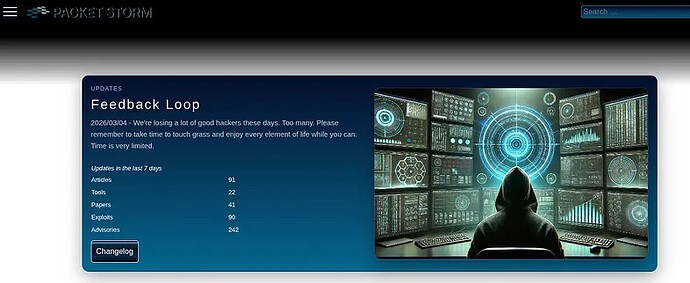
https://packetstorm.news/files/author/10292/1
I began submitting shellcodes, exploits, tools, and other resources to Packet Storm Security starting in 2010, and I came to know the person running the site — a man named Todd, who has always been very kind to me. I sincerely wish him good health and a long life.
Ventures into Robotics

Building on my background in electronics, I began building robots in 2013. I documented my projects on a blog at https://sw0rdm4n.wordpress.com , and some of the robots I built can be viewed at https://www.bluedragonsec.com/var/robotic/
Robotsoft Indonesia
Ringlayer Robotic Channel "Deep Learning Robotic Channel" https://www.ringlayer.com https://ringlayer.github.io…
2013 to 2015
In 2013–2015, I was recruited by a state intelligence agency focused on counterterrorism, during a period of heightened concern over the ISIS threat. My responsibilities included tracking the whereabouts of terrorist suspects and conducting penetration operations against radical Islamic websites.
In 2015, I also built a Wi-Fi hacking robot and demonstrated it during an IT security training session I delivered for BPPT (the Agency for the Assessment and Application of Technology).
Press enter or click to view image in full size

The training I conducted at BPPT covered exploitation techniques on Windows — including the fundamentals of stack overflow, Structured Exception Handler (SEH) exploitation, and egg hunters — as well as Linux topics, including remote stack overflow exploitation, bypassing Stack Smashing Protection (SSP) via byte-by-byte brute force, and ASLR bypass using Return-to-libc (ret2libc).
https://www.youtube.com/watch?v=GSlHgUB-yaA (this video actually taken in 2015, reposted 6 years ago)
2016

In 2016, I was engaged by the son of a senior police general in Indonesia, with the task of developing Wi-Fi hacking devices and IMSI catchers. Those who are interested in hardware hacking will likely recognize some of the devices I worked with, such as the RTL-SDR, HackRF, and BladeRF.
2017–2019
I developed an open source dns server for linux and freebsd, it’s called rldns :
Bot Request Blocked
Bot detected. Please consider purchasing API access for any automation needs. Scraping is prohibited and can result in…

GitHub — bluedragonsecurity/rldns: rldns is an open source lightweight DNS server for…
rldns is an open source lightweight DNS server for linux, netbsd, freebsd, and openbsd. Runs on x86 and x86_64. Latest version : rldns-1.4 — released on Feb 2026 I did fids (flight information display system) installations for airports in Indonesia

Failed Startups
In 2020, I was less active in the security field because I was busy with my first startup — a solar panel installation service company called Freenergi. With nothing more than business cards, a home office, and a handful of outsourced staff, I boldly launched the venture. Unfortunately, it failed.
https://www.youtube.com/@Freenergi
Undeterred, I attempted another startup — Robotsoft — which produced IoT devices that I designed and built myself.
robotsoft
Robotsoft - Better Technology for a Better Life - Website : www.robotsoft.co.id

Sadly, this venture also failed. I continued attempting additional startups through 2025, but all of them ultimately ended in failure.
It is worth noting that I have been running all of these businesses entirely on my own. Perhaps one day I will find success if I have the right business partner.
Identity Concealment
From 2003 to 2024, I regularly concealed my identity in underground circles, never using my real name. Over the years, I adopted various nicknames, including mranton, ev1lut10n, sw0rdm4n, b4tm4n, wisdom, and d4r3d3v1l. Today, I use my real name — Antonius — for the purpose of advancing my professional career in IT security.
My Secrets to Staying Youthful (Bio Hacking)
I practice biohacking . Some of the simple biohacking methods I regularly follow include consuming herbal supplements.
The herbs I frequently consume include:
- Goji berries
- Centella asiatica (Gotu Kola)
- Ginseng (Shen)
- Fo-ti (He Shou Wu)
- Lingzhi mushrooms (Reishi)
“Actually, there are other biohacking techniques that I practice to make my face look younger, but for certain reasons, I can’t share them.”
And I practice 4 different martial arts : muay thai, tae kwon do, boxing, brazilian jiujitsu
2026
There is a notable IT security community in 2026 called https://0x00sec.org, which I occasionally visit.

